



" What kind of lifting procedure should I get? "
This is the question most frequently heard in the counseling room.
However, the word "lifting" has various meanings mixed together.
Facelift surgery is a lifting procedure, threads are a lifting procedure, and lasers or ultrasound equipment are also referred to as lifting.
Today, I would like to divide lifting procedures into three main categories and summarize the differences between them and who is suitable for each.
There is a sequence to lifting.
The order in which you approach lifting can be divided as follows.
Device lifting → Thread lifting → Facelift
The further to the right you go, the stronger the lifting intensity becomes in a single pass.
Instead, the recovery period becomes longer, and concerns about scarring arise.
Conversely, as you move to the left, the impact on daily life is minimal, but the lifting intensity also weakens.
If we divide them into three, they differ starting from the layer in which they act.
Even within the same 'lifting' procedure, the areas and methods of tightening differ.
So, what is better depends on your current facial condition.
1. Facelift - The Most Powerful Effect, a Double-Edged Sword
It is a surgery commonly referred to as a facelift, and its official name is rhytidectomy .
After making incisions in front of and behind the ears and along the hairline,
Dissect the skin and the underlying SMAS layer and pull it upward,
Cut off any excess skin.
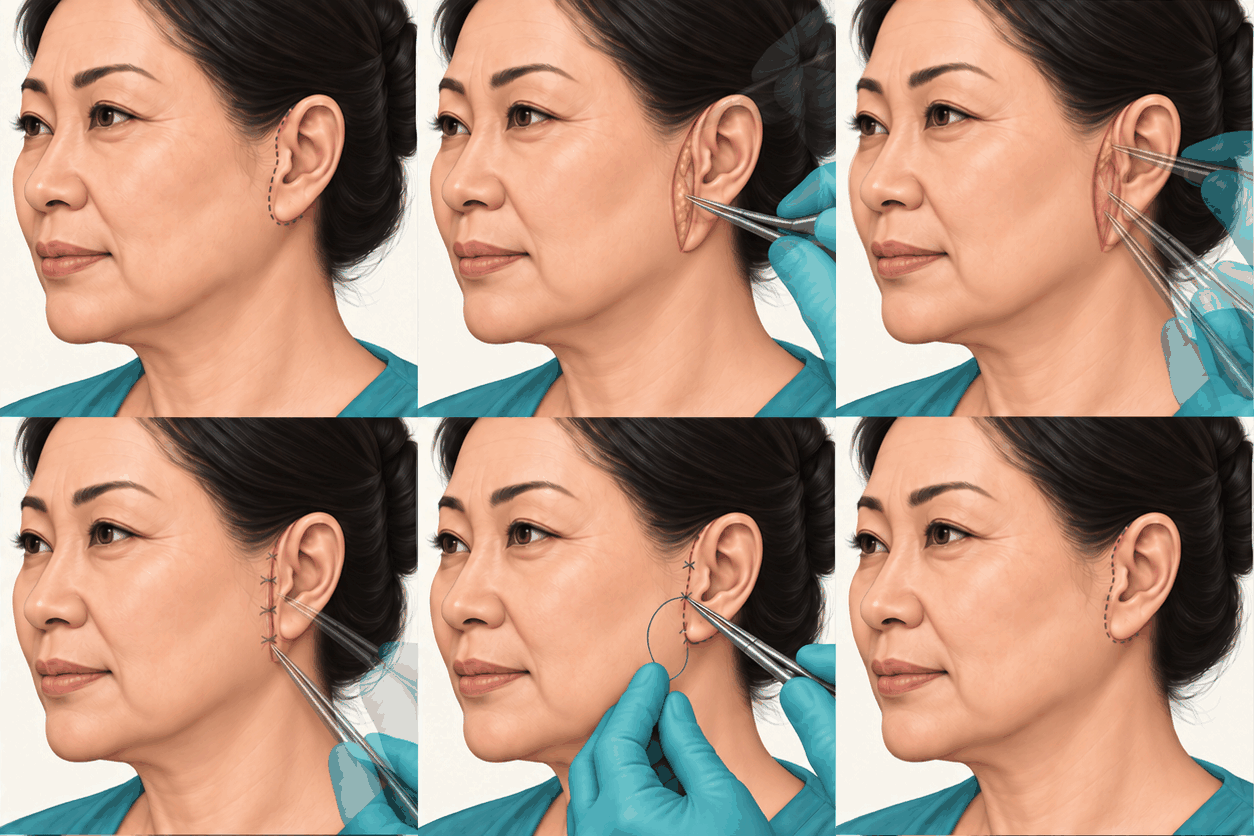 A brief description of the facelift process
Because it directly transplants sagging tissue and removes excess skin
Among the three, it has the strongest and longest-lasting lifting effect.
However, since it is surgery, you may be concerned about the recovery time and the surgical scar.
Sleep or general anesthesia is required, and significant swelling and bruising last for about 2 to 3 weeks, and it takes 3 to 6 months for it to settle naturally.
In addition, incision scars will remain in front of and behind the ears and along the hairline. Although these locations are well concealed, it is difficult to achieve a completely scar-free procedure.
During the consultation, I honestly recommend surgery to those who believe they would be more satisfied with it than other lifting procedures.
2. Thread Lifting - Surgery? Procedure? Semi-surgery?
To help you understand, I would like to mention that thread lifting falls halfway between surgery and a procedure.
It is not that there is absolutely no downtime, but this expression is frequently used because the tissue is pulled directly using thread.
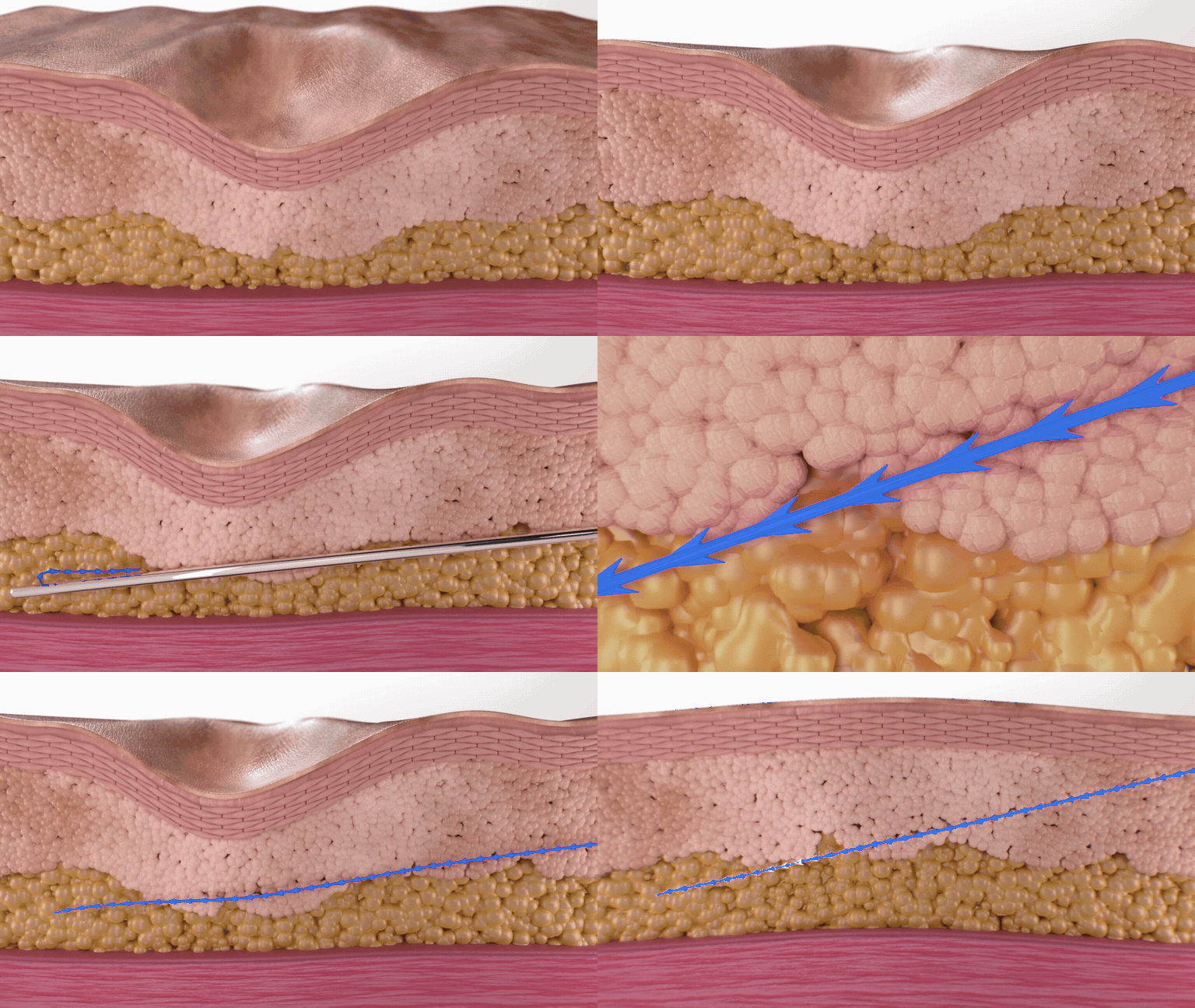 Thread lifting using barbed threads
In other words, thread lifting is a procedure that involves inserting dissolvable threads into the fat layer beneath the skin to lift sagging tissue.
The protrusions on the thread grasp the fat layer and the fascia layer , and are fixed upward in that state.
Since there is no incision, the scar is only at the insertion point of the needle (using a 19G needle (inner diameter of about 1mm)) .
The procedure is performed under local or sedation anesthesia, and major swelling lasts for about 1 week, while residual swelling lasts for about 2 to 3 weeks.
The duration is usually 6 to 12 months, and depending on how it is performed, it may last for more than a year.
Nowadays, thread lifting does not simply pull.
A method of repositioning the sagging fat layer back to its original position and supporting it from below ( sil sculpting ),
Just like threads used to add volume to sunken areas (such as Jamber threads ), the type of thread and the direction of insertion vary depending on the purpose.
3. Device Lifting - Contracts tissue and destroys fat.
Device lifting is a method of delivering energy into the skin using equipment without needles or incisions.
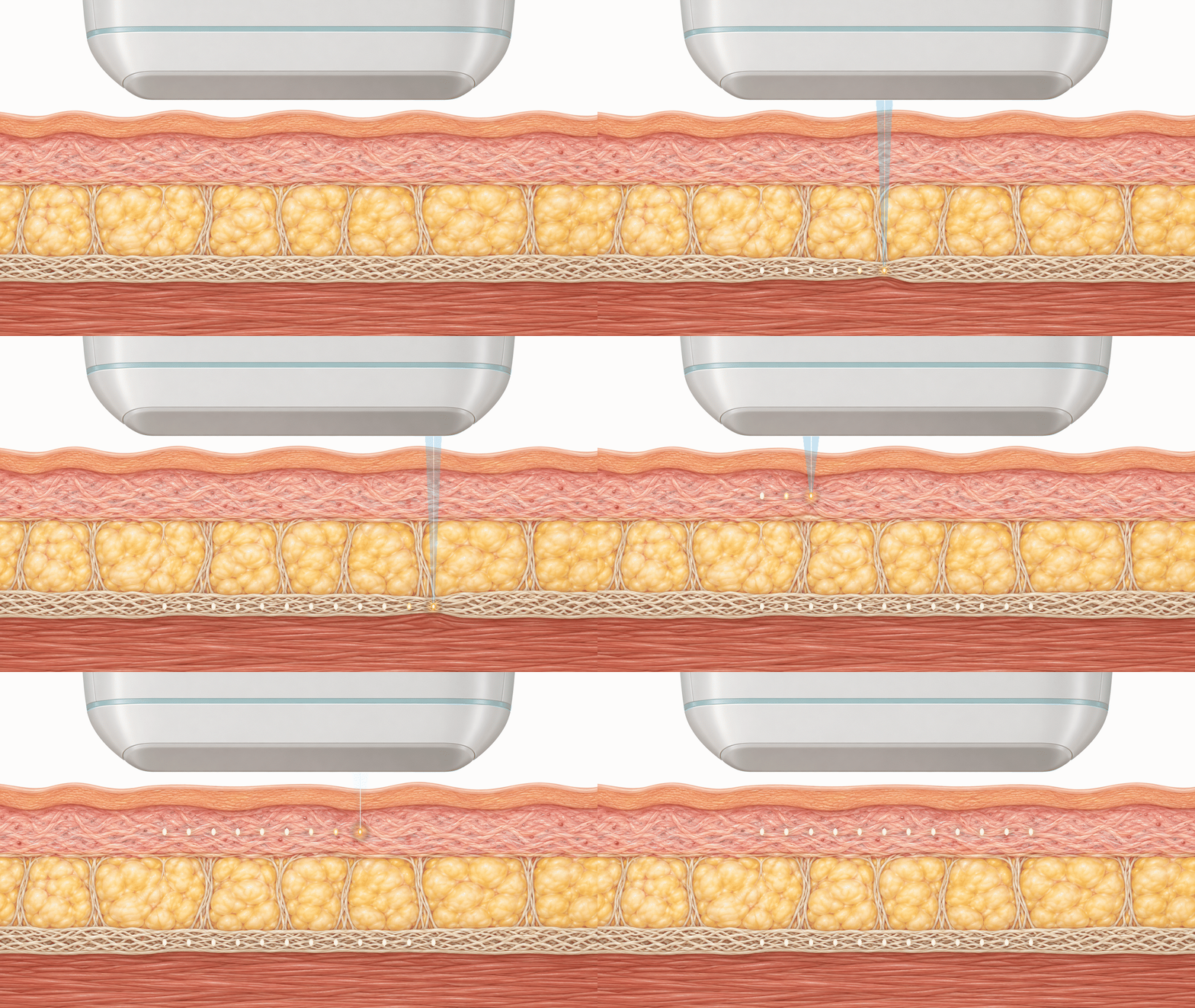 Device lifting that gathers energy to contract the skin layers
Ultrasound (HIFU) - Like Ulthera Prime and Shrink Universe, it focuses ultrasound energy at a single point to act on the SMAS layer.
Radio Frequency (RF) - Like THERMAGE FLX, Oligio, and Volneumer, it improves the elasticity of the dermis layer using thermal energy generated by radio frequency.
Electrical Stimulation (HIFES) - Like EMFACE, it causes muscles to contract on their own through electrical stimulation.
Collagen that receives thermal energy immediately contracts, and then new collagen is created over the next few months.
Therefore, the effects tend to develop over time rather than immediately after the procedure.
In most cases, daily life is possible on the same day, and there are no scars.
Instead, the degree of lifting effect from a single procedure is the lowest among the three, and it is a procedure that is repeated at intervals of 3 to 12 months to maintain.
4. Compare at a glance
In summary, surgery is the most effective in terms of intensity and duration , and
Device lifting minimizes concerns regarding recovery speed and scarring .
You can consider thread lifting to be somewhere in between . (That is why I call it semi-surgery.)
5. What kind of lifting do I need?
I check the current layer and degree of sagging skin first, rather than age.
This is because even among people in their 50s, there are those whose entire skin layer is sagging, and others who have only lost elasticity.
People suitable for a facelift
Those who have enough room in the sagging skin below the jawline and on the neck to fold.
For those who have received thread lifting or device lifting multiple times but have not seen sufficient results
For those who want a definite change all at once and want it to last.
Those who can spare a recovery period of about 2 to 3 weeks and are in good health to withstand surgery and anesthesia.
People suitable for thread lifting
Those who have visible sagging in their cheeks, nasolabial folds, deep cheek fat, and jawline, but with excess skin that isn't severely loose.
For those who find a device alone insufficient but are hesitant about surgery
For those who want to restore volume to sunken areas along with sagging
Those who are okay with swelling for about a week
People suitable for device lifting
Those who feel that sagging is mild but elasticity has decreased and the skin has thinned
Those who need to return to their daily lives immediately without a recovery period
For those who want to manage it in advance before it sag
For those who want to maintain the effects of surgery or thread lifting for a long time
6. You don't necessarily have to choose just one.
Various lifting procedures are also performed in combination .
Aging continues even after a facelift . That is why many people maintain their results with device lifting after surgery.
There are also cases where sagging tissue is lifted with thread lifting and skin elasticity is restored with device lifting .
Therefore, during the consultation, we first identify what lifting method is most needed at that moment.
The recommended procedure varies depending on whether the issue is sagging skin, sunken fat, reduced volume, or decreased elasticity.
7. Frequently Asked Questions
Q1. At what age is it recommended to get a facelift?
Condition is the criterion, rather than age. Many people start with a device when they feel elasticity is beginning to decline, and consider thread lifting when sagging becomes visible.
Q2. Are there any precautions to take after a thread lift?
Please avoid opening your mouth wide or performing facial massages that apply strong pressure for 1 to 2 weeks after the procedure. Initially, you may experience a feeling of tightness or slight indentations, but these usually settle as the swelling subsides. If these issues persist, please be sure to visit the clinic.
Q3. How many sessions of device lifting are required?
It varies depending on the equipment. There are devices like Shurink that require multiple sessions initially, and devices like Ulthera Prime or THERMAGE that require sessions every 6 to 12 months.
Q4. Does a facelift last a lifetime?
While surgically lifted tissue lasts for a long time, aging itself does not stop. Maintenance is necessary because sagging resumes over time.
8. In conclusion..
To summarize, it is as follows.
A facelift is the strongest and longest-lasting option, but as it is surgery, there is a risk of a long recovery period and scarring.
Thread lifting pulls, lifts, or adds volume to sagging tissue with threads without incisions.
Device lifting involves the least burden of the procedure, but requires repeated treatments.
Before choosing a lift,
It is best to first determine which lifting method is most suitable for your face right now.
I am active as a director at the Korean Society of Lifting and am updating the latest information on various lifting procedures .
I plan to continue explaining these details one by one.
I hope this article helps answer the question , "Which lifting procedure should I get?"
This has been Seo Min-ho. Thank you for reading.