



Hello, this is Lee Jae-hee, the Director of EPISODE CLINIC.
This article summarizes the differences between sedation anesthesia and general anesthesia, what propofol is, what the doctor monitors during the treatment, and how the patient wakes up.
I am Anesthesiology and Pain Medicine SpecialistI used to perform anesthesia in the operating room of a university hospital, and now, while providing medical care at EPISODE, I am establishing the methods and standards for sedation anesthesia.

When the topic of sleep anesthesia comes up in the consultation room, three or four out of ten people say this.
I'm a bit scared of sleep anesthesia.
"Isn't propofol dangerous?"
What if I can't wake up from sleep?
I understand. You have seen stories on the news, and it is understandable that you feel anxious about not knowing what might happen while you are unconscious.
So, starting with this post Three partsI would like to talk about sleep treatment over the course of a while.
Part 1 is It covers what sedation anesthesia is, how it differs from general anesthesia, and what medications are used and how.
Part 2 is How sleep treatment are actually performed in the EPISODE,
Part 3 is This is a frequently asked question.
1. Sleep anesthesia is not general anesthesia.
First, let's clarify the terminology.
"Sleep anesthesia" is not a formal medical term, and medically, sedationIt is called that. It does not completely eliminate consciousness, but rather puts the person into a comfortable state as if they were asleep.
Anesthesia comes in different levels. Mild methods, such as anesthetic creams or local anesthesia, eliminate sensation only in the painful area while keeping the patient conscious; at the deepest level is general anesthesia performed in the operating room. Sedation falls somewhere in between.
The biggest difference from general anesthesia is breathingno see.
Since general anesthesia removes the ability to breathe on one's own along with consciousness, a tube is inserted into the airway and breathing is replaced by a machine.
Sleep anesthesia is for the patient It breathes on its own.Therefore, the procedure is performed without inserting a tube through the mouth, delivering oxygen only through the nose.
They ask, "Are you breathing while you sleep?" and yes, he/she is continuously breathing.
The doctor performing the treatment continuously monitors the breathing using a monitoring device to ensure it is being maintained properly. Oxygen saturation, respiratory rate, pulse, blood pressureCheck.
| local anesthesia | sleep anesthesia | general anesthesia | |
|---|---|---|---|
| consciousness | Awake | asleep | doesn't exist |
| breathing | self | self | Instead, the machine |
| pray | like that | Oxygen through the nose | Tracheal intubation |
| Memory during the treatment | is | doesn't exist | doesn't exist |
| To wake up | Not applicable | 5~10 minutes | tens of minutes |
| place where it is done | treatment room | treatment room | operating room |
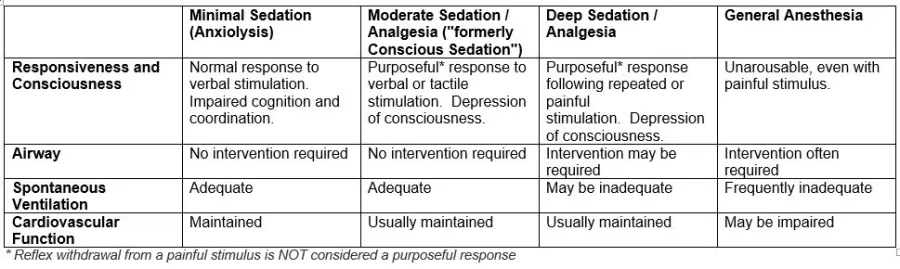 Depth of anesthesia by stage
There is depth to sincerity as well.
Answers when spoken to Minimal calmingFrom showing purposeful responses to sound or touch Moderate sedation, with respiratory depression and responsive to continuous or painful stimuli Deep calming, and as respiratory and cardiovascular functions decline, there is no response to pain general anesthesiaThere is.
The target depth for cosmetic treatment is a moderate level of soothing.
Deeper sleep is not necessarily better, as deep sleep can cause spontaneous breathing to cease, so the treatment is performed at a depth appropriate for the patient.
Therefore, the medication is continuously adjusted according to the level of pain even during the treatment.
2. What medication do you use?
The most commonly used drug for sleep anesthesia is PropofolIt is. It was nicknamed "Milk Injection" because of its white, milk-like color.
The advantage of propofol is that it is fast. Once it is administered intravenously... Fall asleep within 30 seconds to 1 minute, if you stop the medication Wake up within 5 to 10 minutes.It does not linger in the body for long, so there is less groggy feeling after waking up, and nausea is also relatively mild.
There are also clear downsides. Depending on the dosage, breathing may become shallow and blood pressure may drop.
Therefore, oxygen saturation, etc. It is important to stay calm while monitoring. With the monitoring device, you can find out more quickly whether the patient is breathing properly and if their blood pressure is okay.
| propofol | ketamine | |
|---|---|---|
| line | intravenous anesthetic | Dissociative anesthetic |
| characteristic | Milk injection, grab quickly and get out quickly | Pain relief, maintenance of respiration and blood pressure |
| To fall asleep | 30 seconds to 1 minute | 30 seconds to 1 minute |
| To wake up | 5~10 minutes | 10~15 minutes |
| role | Sleep, adjust depth | Pain block, reduced propofol dosage |
| Things to watch | Respiration, blood pressure | Dreams upon waking, dizziness |
together with propofol KetamineThere are also hospitals that use it. As it is a strong anesthetic, it reduces the sensation of pain during the treatment and, unlike propofol, tends not to lower respiration or blood pressure.
However, if the dosage of ketamine is high, it can cause dreaming or dizziness upon waking and increase intracranial and intraocular pressure, so it is important to carefully assess the patient's underlying conditions.
"How much" of medicine to add depends on weight, height, age, medications you normally take, and whether you consume alcohol or sleeping pills.
So, instead of putting in a fixed amount all at once, It is safe to adjust little by little while observing the reaction.
3. What is the doctor looking at during the treatment ?
The most important thing a doctor does after a patient falls asleep is to "watch."
finger-worn pulse oximeterContinuously monitoring the oxygen concentration in the blood, blood pressureRestock at 5-10 minute intervals, electrocardiogramI monitor the heart rhythm. I look at the breathing rate as numbers, but I also visually check the rise and fall of the chest from time to time to ensure proper breathing.
If oxygen saturation drops even slightly, we lift the chin to open the airway, increase the administered oxygen, or reduce medications such as propofol. In most cases, the condition returns immediately at this stage.
4. The Process of Waking Up, and Memory
We begin reducing the medication 5 to 10 minutes before the treatment ends. Since propofol leaves the body quickly once stopped, you will open your eyes around the time the treatment is finished.
"Is it already over?" is what they say most often when they wake up.
It is normal not to remember.This is because the medication prevents the storage of memories from just before falling asleep until waking up. Even if you had a slight reaction during the treatment, you will not remember it.
| After waking up | 20–30 minutes in the recovery room, check for gait and dizziness |
| Avoid on the day | Driving, alcohol, important decisions |
Even after waking up, it takes more time for the medication to completely leave the body. In particular, immediately after the treatment, oxygen saturation may drop because there are no painful stimuli and the anesthetic still remains in the body. Therefore, in the recovery room after the treatment... 20 to 30 minutes You rest while monitoring the level of the monitoring device. You go home after confirming that you have fully woken up from the anesthesia, are walking straight, and are not dizzy.
On the day driveYou must avoid this. This is because there is a risk of an accident due to the potential dizziness caused by the anesthetic on the day.
5. So, is sleep anesthesia okay?
To summarize, it is as follows.
Sleep anesthesia performed at a cosmetic dermatology clinic is shallower than general anesthesia and is administered while the patient is breathing on their own.
The medication used takes effect quickly and is eliminated from the body just as quickly, and the danger arises not from the drug itself, but from "situations where no one is watching."
The principle of gradually adjusting the medication while monitoring the device.As long as you follow these guidelines, sleep anesthesia for cosmetic treatment can be performed safely.
However, we do not recommend this to everyone. There is no reason to undergo sedation for treatment where anesthetic cream or local anesthesia is sufficient, and Patients with severe sleep apnea, heart or lung disease, allergies, or a history of adverse reactions during previous anesthesiaYou must mention this during the consultation. I will discuss this in detail in Part 2.
In the next Part 2, I will explain how the sleep treatment is performed in the EPISODE, in order from fasting to returning home.
Thank you for reading.