


" Doctor, how many units of Botox should I get ?"
This is one of the most frequently asked questions in the counseling room.
However, I cannot answer this question simply.
Today, I am going to dig deep into Botox.
I will write down, in order, what Botox is an injection for, why you must determine the design and dosage before getting it, and how much is injected into which muscle.
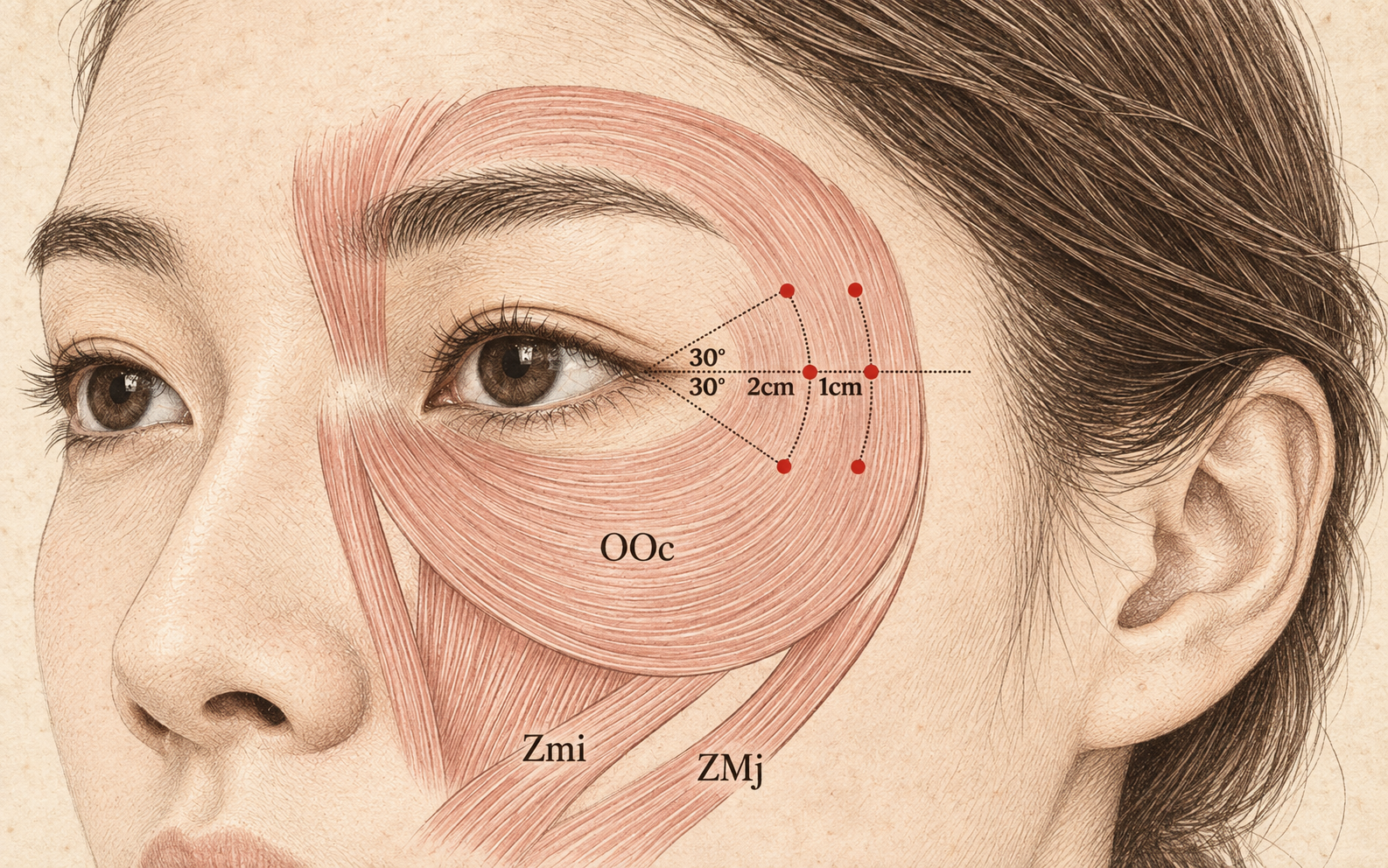 Botulinum toxin procedures where anatomical understanding is important
1. Why are the results different even though it is the same Botox?
I got the same product and the same unit as my friend.
My friend looks natural, but my expression is awkward.
Or my friend's jawline has become slimmer, but I haven't seen any change.
I hear stories like this really often.
The reason is simple.
This is because the size, strength, and location of muscles differ from person to person.
In terms of clothes, it is like this.
Even if made from the same fabric, ready-made clothes produced without taking measurements are too big for some and too small for others.
The same goes for Botox.
If the product is the fabric, then the design and capacity are the dimensions.
So, regarding Botox, I don't refer to it as " which product in which units "
"Which muscle, at what depth, how much"
I believe that is the most important thing.
2. What is Botox an injection for?
The correct name for Botox is Botulinum Toxin. (For the sake of ease of understanding, I will refer to it as 'Botox' in this article.)
It does exactly one thing: reduce the signals sent by the nerves .
However, depending on where that signal was headed, the results are divided into three categories.
Wrinkle Reduction - It reduces signals to facial muscles to relieve excessive contraction. This applies to wrinkle Botox for the forehead, between the eyebrows, and around the eyes.
Volume Reduction - Muscles that have enlarged due to overuse gradually decrease in volume as they are used less. Muscle Botox , such as for the square jaw, temporalis, trapezius, and calves, falls into this category, as does body Botox . Salivary Gland Botox, which reduces the size of salivary glands rather than muscles, follows the same principle.
Secretion inhibition - reduces signals to sweat glands and sebaceous glands. This includes hyperhidrosis Botox and skin Botox , which is injected into the shallow layers of the skin to reduce pores and oil.
It is the same drug, but the results are so different.
To produce different results, the injection location, depth, and amount all change.
3. Why Design Comes First - Where and How Deeply
There are three main factors that determine the results of Botox.
Injection location, injection depth , and volume.
I call determining the position and depth among these "design."
1) Injection site
The toxin spreads over a certain range from the injection site.
So, even moving just a little to the side can relax unwanted muscles.
Let me take the forehead as an example.
The forehead muscle is the muscle that lifts the eyebrows.
If you let it loosen too much close to your eyebrows, your eyebrows and eyelids will droop heavily.
Conversely, if you loosen only the middle and leave the outer part intact, the tails of the eyebrows will be lifted upward, creating an angry impression .
Therefore, the forehead is divided into several points over a wide area.
You must evaluate the range of action of the forehead muscle and inject accordingly.
The same goes for square jaws.
If you place it too far forward or upward on the masseter muscle, it affects the muscles used for smiling, making your smile look awkward .
A side effect may occur where the side cheeks appear sunken .
Therefore, avoiding facial muscles and salivary glands, insert it focusing on the lower, outer area where the masseter muscle is thickest.
The temporalis muscle confirms the course of the superficial temporal artery passing through the temple, and
It is divided and inserted at several points, centering on the area that becomes most convex when biting the molars.
2) Injection depth
Even with the same Botox, the procedure becomes completely different depending on the depth at which it is injected.
Skin Botox - The shallow layer of the skin to avoid excessively affecting facial muscles
Hyperhidrosis Botox - Dermis layer where sweat glands are distributed
Wrinkle Botox - Thin facial muscles
Square jaw, temporalis muscle, body Botox - Deep into the muscle, not the skin; for the temporalis muscle, the muscle layer beneath the fascia
Salivary Gland Botox - Inside the salivary glands, not the muscles
If the injection depth is incorrect, the medication may be administered but have no effect, or unwanted results may occur.
3) The dilution amount (cc) is also part of the design.
Unit (U) is a unit representing the effect, and cc is the amount of water in which the medicine is dissolved.
Even with the same 10 units, if you dilute it heavily, it spreads widely , and if you dilute it lightly, it acts narrowly and intensely .
Therefore, Skin Botox, which needs to be spread densely across the entire face, is applied widely,
The strong force is applied precisely to the necessary point.
4. Capacity is determined by 'muscle size × strength'.
Now, let's talk about capacity.
The principle is simple.
The larger, thicker, and stronger the muscles, the more capacity is required.
The muscles that form wrinkles around the eyes are thin and delicate. A few units are enough.
The masseter muscle, which clenches the molars tightly, is thick and strong. Dozens of units are required.
The trapezius and calf muscles, which support the body all day long, are much larger. They increase in increments of 100 units.
In that case, is it better to add more?
no.
If the dosage is insufficient, the effect is weak and wears off quickly. As a result, you end up getting injected more frequently.
If the dosage is excessive, your facial expression may become stiff, your forehead may feel heavy, your temples or cheeks may appear sunken, or you may get easily fatigued when chewing.
Body Botox can reduce the strength needed for daily activities .
And even within a single person's body, left-right symmetry differs.
The masseter muscle on the chewing side is larger, and the trapezius muscle on the frequently used side is thicker.
So, instead of putting it in equally on both sides, you need to feel the left and right sides separately and put it in.
5. How much dosage is used for each area?
Below is a summary of commonly used dosage ranges based on muscle size and strength.
Please view this as a guide to get the hang of it, not an answer key.
1) Small and delicate facial muscles - Wrinkle Botox
Forehead - Broad and thin muscle, distributed across multiple points - 6~15U
Between the eyebrows - Small but thick and strong muscle - 10~20U
Eye area - thin circular muscle, to prevent facial expressions from stiffening - 4~10U per side
Under-eye area - Very thin and delicate - 1~2U per side
Bridge of the nose, nostrils, columella - small muscles - 2~6U
Corners of the mouth - Small muscles that pull the corners of the mouth down - 2~5U on each side
Pebble chin - Muscle that makes the chin tip bumpy - 4~10U
Facial muscles are small and thin, so even a slight difference in volume changes the facial expression.
So, "seeming a little lacking" is actually more natural here.
2) Thick and strong muscles, glands - Contour Botox
Square jaw (mastoid) - A thick, strong muscle that bites the molars - 50~100U on each side
Temporalis muscle - the fan-shaped muscle of the temple; hyperactivity leads to hollowness - 30~70U on each side
Salivary glands (parotid gland, submandibular gland) - non-muscular secretory glands - 50~100U on each side
The masseter muscle is divided into two layers.
So, instead of pouring it all into one place, we inject it in layers.
For those with highly developed muscles, it is better to achieve better results by delaying recurrence through repeated treatments and improving maintenance, rather than trying to reduce them all at once.
3) Large and strong body muscles, sweat glands - Body Botox, Hyperhidrosis Botox
Trapezius muscle - a large, broad muscle that supports the shoulder - 100~300U on each side
Calves - Strong body-weight supporting muscles - 100~300U on each side
Forearm - Medium-sized muscle - 100~200U on each side
Thighs - the largest muscle group in the body - 200~300U on each side
Hyperhidrosis (armpits, palms and soles) - Dermal sweat glands - 100~200U
Body muscles are also essential for daily movements.
So, leaving some strength behind, I insert it focusing on the area where the muscle feels thickest.
4) Shallow layer of skin - Skin Botox
The purpose of skin Botox is not to reduce muscle mass.
Dilute 10–40U for the entire face and apply small amounts densely and evenly to the shallow layers of the skin,
It refines fine lines, pores, oil, and skin texture all at once.
One more thing to add: the above dosages are based on the units commonly used for Botulinum Toxin Type A.
Since the unit system may vary from product to product, you should not compare Dysport products directly with other products based solely on the numbers.
And above all, since everyone's muscle mass is different, the range is written broadly. (If you compare athletes and skinny models...!)
6. In the EPISODE, it is decided as follows
The process for determining the design and capacity is as follows.
Muscle Check - For wrinkle Botox, we have you lift your forehead, frown, and smile to observe where and how your muscles move. For contouring Botox, we have you clench your molars tightly to directly feel the thickness of the masseter and temporalis muscles and the difference between the left and right sides.
Distinguishing between muscle and salivary gland - If the bulging area remains soft and does not harden when you clench your molars, it is highly likely to be a salivary gland rather than muscle. In this case, square jaw Botox alone is insufficient, so salivary gland Botox is recommended as well.
Determination of Injection Points and Dosage - Determine injection points for each site and distribute the dosage separately for the left and right sides.
Product and Volume Verification - You can check the product and volume to be used right in front of you before the procedure.
Procedure Report Record - Records which product was used, where it was applied, and in what amount as an online procedure report.
The last record is more important than you think.
Botox is not a one-time procedure but a repeated treatment.
We need to know where and how much was put last time, and how it reacted afterward.
Next time, you can decide to "reduce here a little and increase here a little."
(I explained this in detail in my previous post, "Why I Obsess Over My Procedure Records.")
7. How do I choose a product?
In this EPISODE, five products are used: Hytox, Coretox, Xeomin, Dysport, and Allergan.
They are all approved botulinum toxin products, and the basic principle is the same.
I recommend Hitox to those getting Botox for the first time because it is the most affordable.
Coretox and Xeomin are products from which the complex proteins surrounding the toxin have been removed.
This can be considered by those who receive repeated injections and are concerned about developing resistance.
There were instances where Disport received feedback that it 'lasts longer' even with the same unit.
Allergan is popular among those seeking genuine products as the original 'Botox' product.
However, what you still need to decide before choosing a product is the design and capacity.
Because even good fabric won't make a good garment if the size doesn't fit.
8. Frequently Asked Questions
Q1. When do the effects appear?
Wrinkle Botox typically begins to show results after 2 to 3 days and settles over a period of 1 to 2 weeks. For procedures that reduce volume, such as those for the square jaw or temporalis muscles, changes are visible over a period of 2 to 4 weeks or more because the muscles shrink gradually.
Q2. How long does the effect last?
While there are individual differences, the duration is approximately 3 to 4 months for wrinkle Botox and 4 to 6 months for muscle Botox. With repeated treatments, muscle regeneration is slowed down, improving the longevity of the effect, and eventually, it is acceptable to reduce the dosage.
Q3. Does it last longer if you get hit a lot?
That is true up to a certain level, but if you inject more than necessary, side effects such as a stiff or sunken facial expression occur before the maintenance period. The dosage tailored to the muscles provides the most natural and long-lasting results.
Q4. How often can I get hit?
It is recommended to receive the next injection after the effects have fully worn off. Frequent injections at short intervals are not recommended.
Q5. I got square jaw Botox, but the bulge below my ears is still the same.
The cause may be the salivary glands rather than the muscles. If the bulge is soft and does not harden when you clench your molars, please be sure to mention it during your appointment.
Q6. Are there cases where it should not be received?
Please be sure to inform your doctor during your appointment if you have a history of hypersensitivity to botulinum toxin, have a neuromuscular disorder, are pregnant or breastfeeding, or have inflammation or infection at the injection site!
9. In conclusion..
To summarize, it is as follows.
Botox is an injection that reduces nerve signals and controls wrinkles, muscle shape, and glandular secretion depending on where it is injected.
The result is determined by where, how much, and at what depth it is inserted, rather than the product.
The dosage must be tailored to the size and strength of the muscles, and left-right symmetry must also be taken into account.
And as records accumulate, it becomes a capacity that suits me.
So, my answer to the question "How many units do I need to get right?" is always the same.
"First, let's start with a muscle check~!"
This has been Seo Min-ho. Thank you for reading.