


"Why are you asking such detailed questions here?"
This is something I sometimes hear from people who have received treatment.
We always keep a record after the procedure is finished, and we make sure to ask , "How was it after the last procedure?" at the next visit.
How effective was it, and were there any inconveniences?
Hello. I am Seo Min-ho, the representative director of EPISODE CLINIC .
This post is closer to my own story than a story about a procedure.
Today, I would like to explain why I am so obsessed with my treatment records.
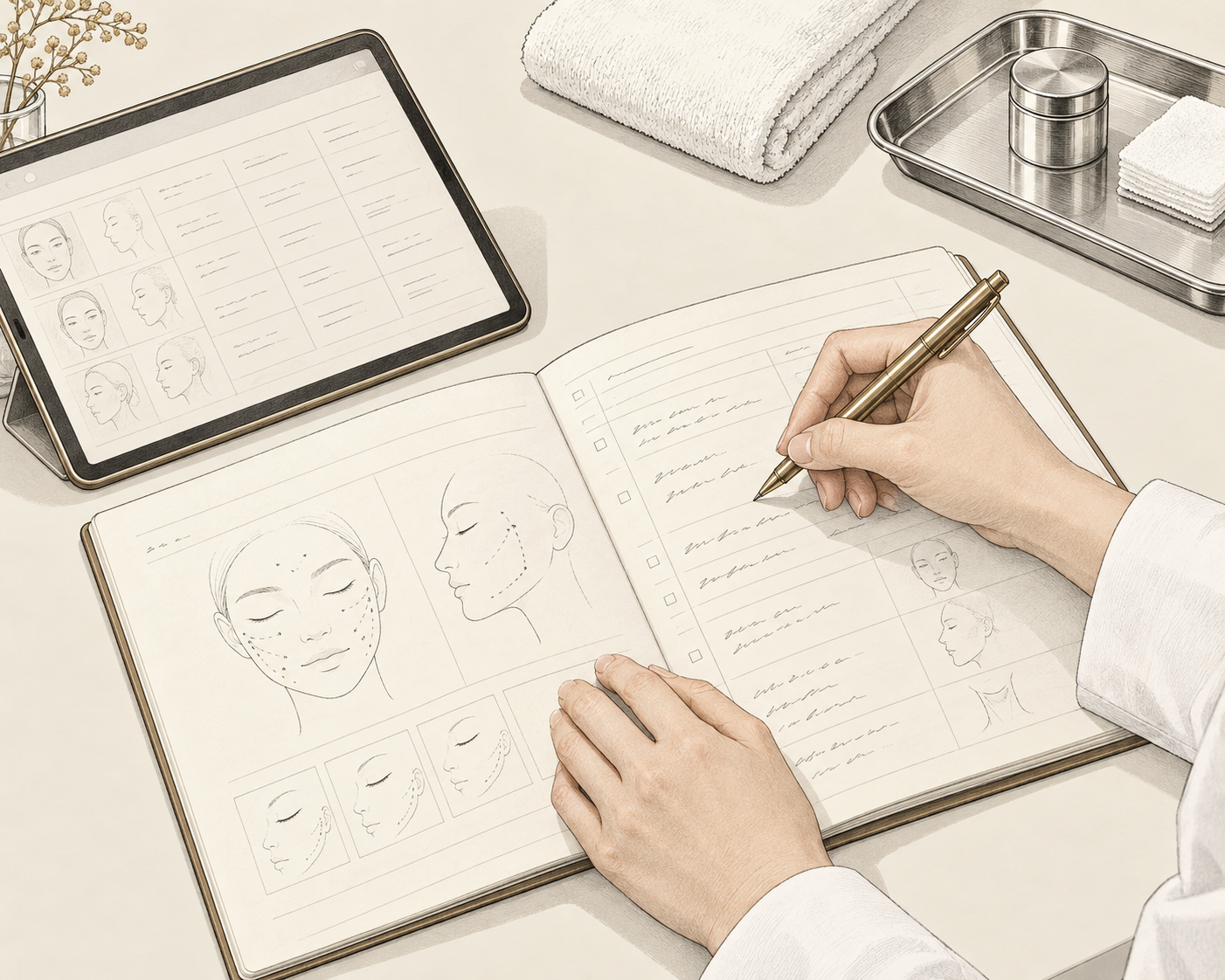 This is an EPISODE where I am serious about charting.
1. There is no single right answer to cosmetic skin procedures.
There is one interesting point when looking at the guidelines for skin care equipment.
Parameters are given as a range much more often than as a single number.
5 to 7, 0.8 to 1.2J, 10 to 20ms.
It is like this.
Why is that?
This is because each patient has a different skin condition and reacts to the same energy to varying degrees.
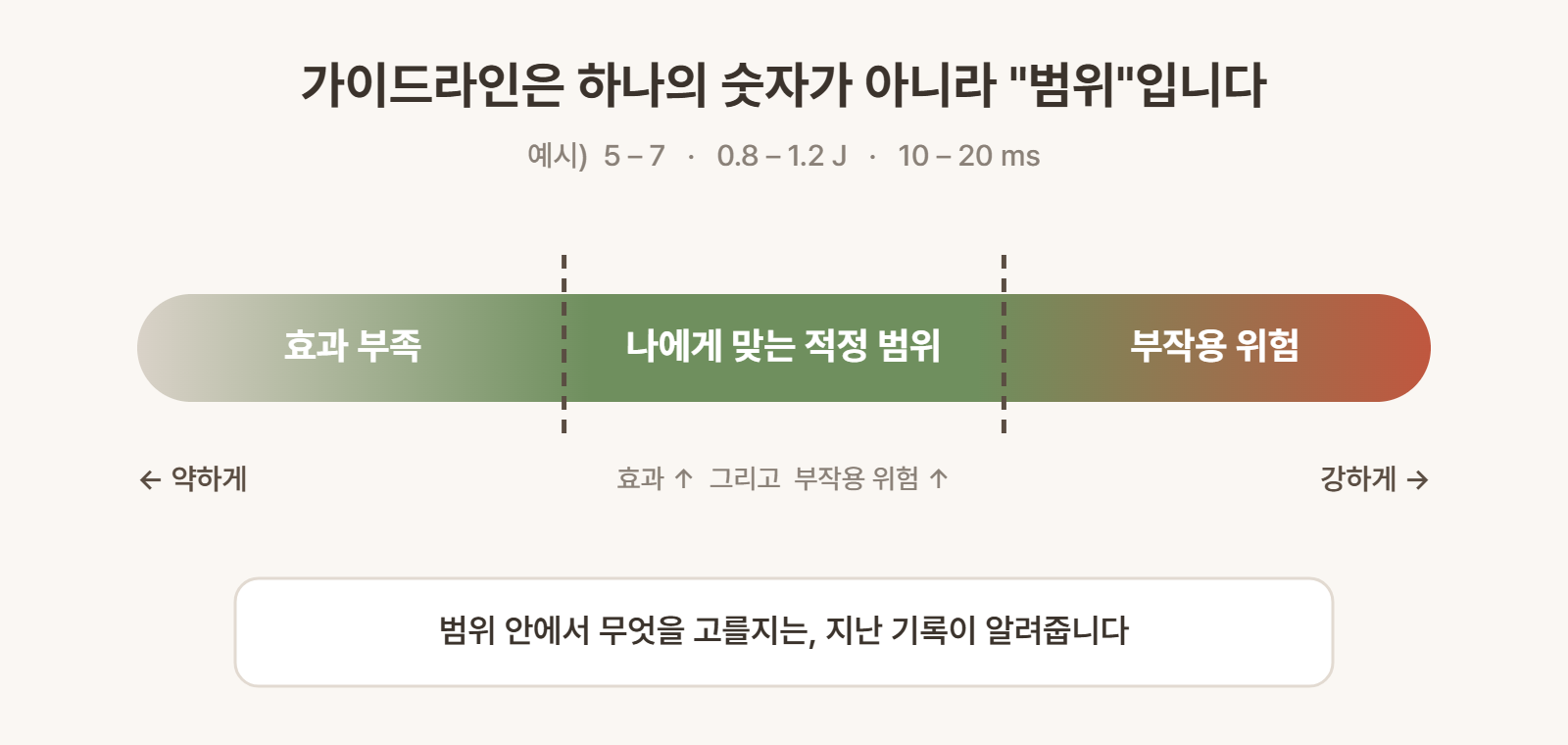 Guidelines are given as a range.
If you go to the lower end of the range, the effect may be insufficient, and
As you move upwards in the range, the effect increases, but the risk of side effects also rises.
Ultimately, a good procedure is
The process of finding the optimal range unique to that individual, ensuring sufficient effectiveness while minimizing the risk of side effects.
I think so.
However, the guidelines do not tell you which number to choose within that range.
The answer lies in the patient's past records.
2. The next procedure requires a previous response.
Many cosmetic medical procedures apply a certain stimulus to the tissue and utilize the subsequent recovery response.
So, to decide how to proceed with this procedure
We must consider the conditions of the previous procedure and the subsequent recovery progress together.
There are exactly three things I always look for in records.
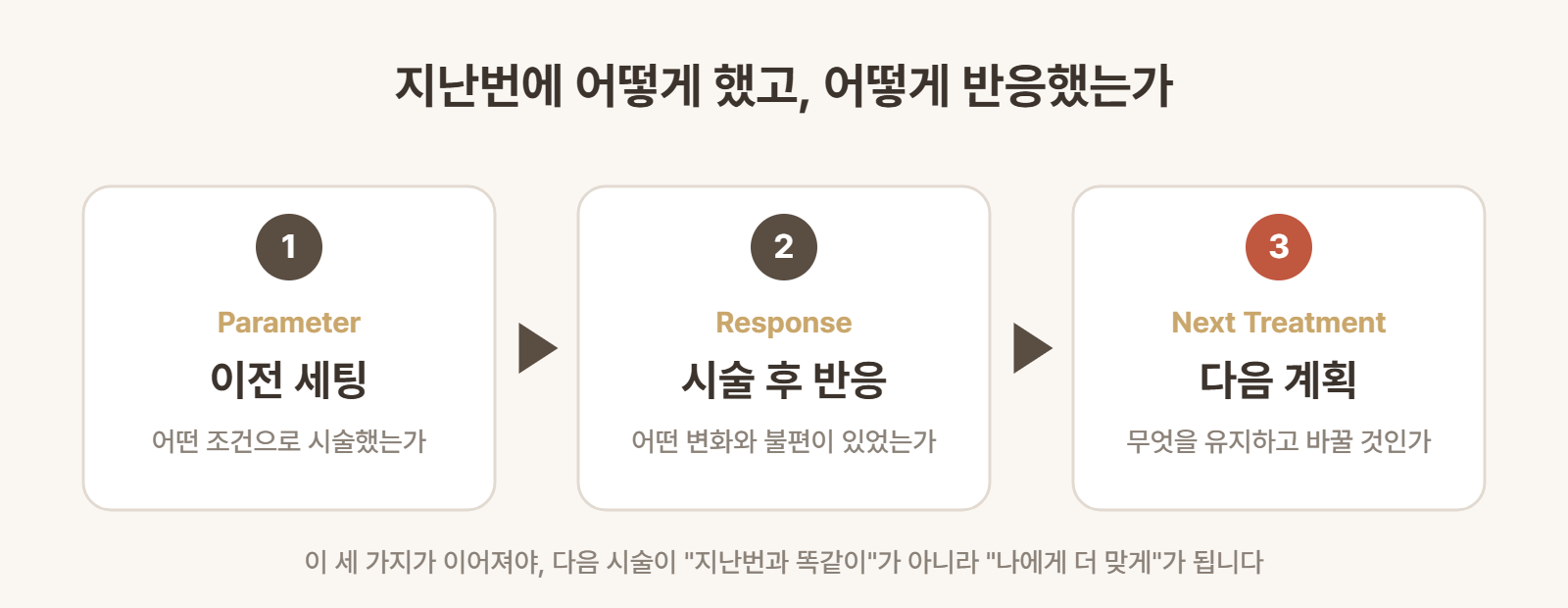 Parameter → Response → Next Treatment
Previous Setting - Under what conditions was the procedure performed
Reactions after the procedure - What changes and discomfort were experienced?
Next Plan - What to Keep and What to Change
These three must be connected for the next procedure
It can be " slightly better suited to me than last time" rather than "exactly the same as last time."
3. If there are no records, we have no choice but to proceed conservatively.
Conversely, what would happen if you couldn't check past records?
From a doctor's perspective, there is no choice but to take a conservative approach.
I don't know what settings were used for the procedure last time, so I can't just proceed aggressively as if I'm seeing it for the first time.
From the patient's perspective, even though it is a procedure performed multiple times, it amounts to receiving it as if it were the first session every time .
However, reading the records thoroughly also takes time.
I have to grasp the flow by flipping through the scattered procedure details and notes one by one for each date, and
As a result, the time spent reading charts increases, rather than the time spent seeing patients.
Therefore , it is just as important to be able to find records immediately as it is to keep them.
4. It started with a single small hair removal card.
The first time I really felt this problem was during hair removal.
Hair removal is a procedure that requires repeated sessions, and parameters must be adjusted as the number of sessions accumulates.
So, at first, I made small hair removal cards and distributed them to the patients.
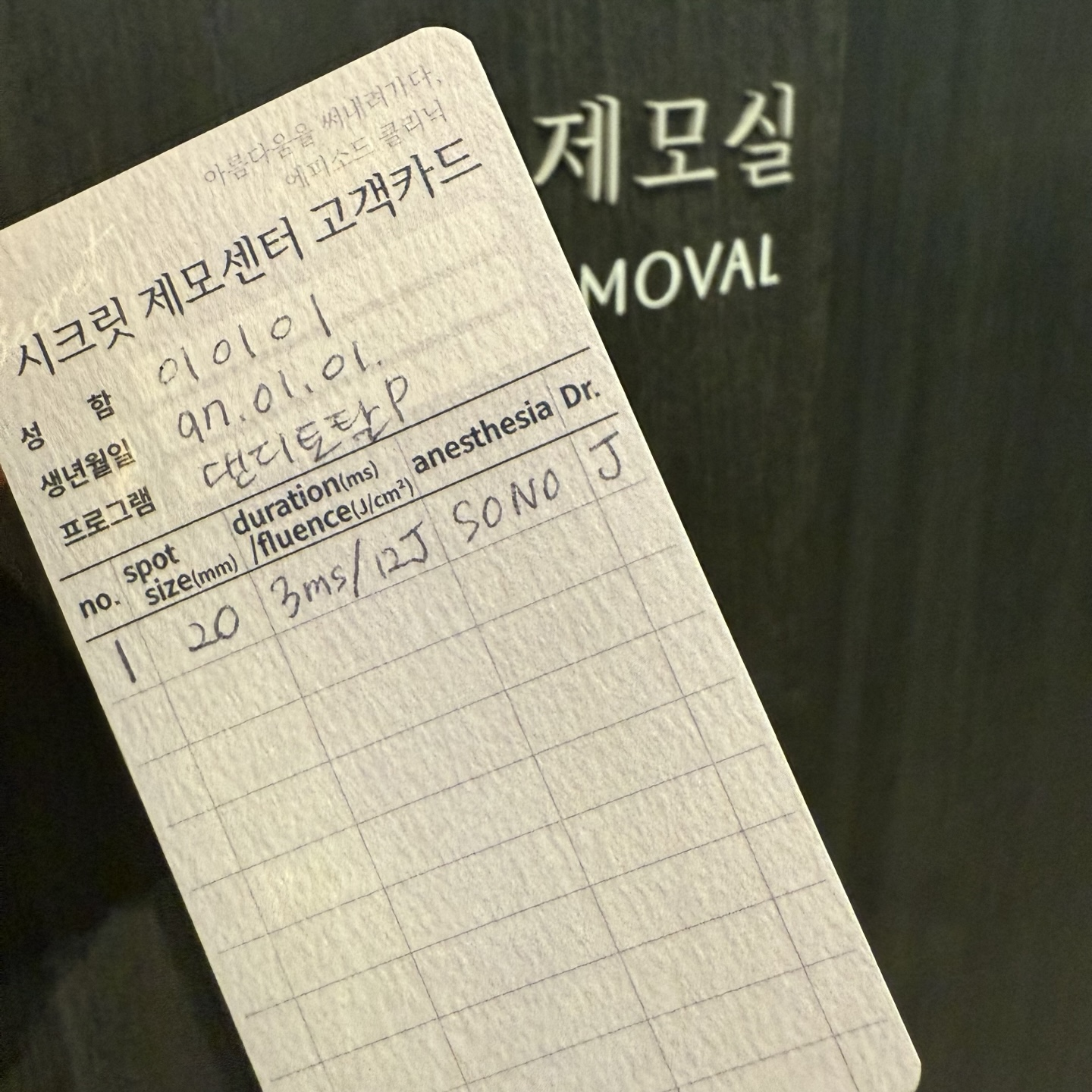 The first hair removal customer card created (example)
I wrote down the spot size , pulse width and energy , anesthesia , and even the doctor performing the procedure by hand.
How I did it last time, and how I will do it next time.
At first, I thought it was a pretty good system.
However, as the number of patients increased, paper cards could not handle it.
They also lose their cards,
It is difficult to find previous records immediately, and
It was also difficult for doctors and staff to share the same information.
Paper was recorded, but it was not searched, shared, or compared.
So, I separated the hair removal section from the chart,
We started structuring and recording procedure parameters and results.
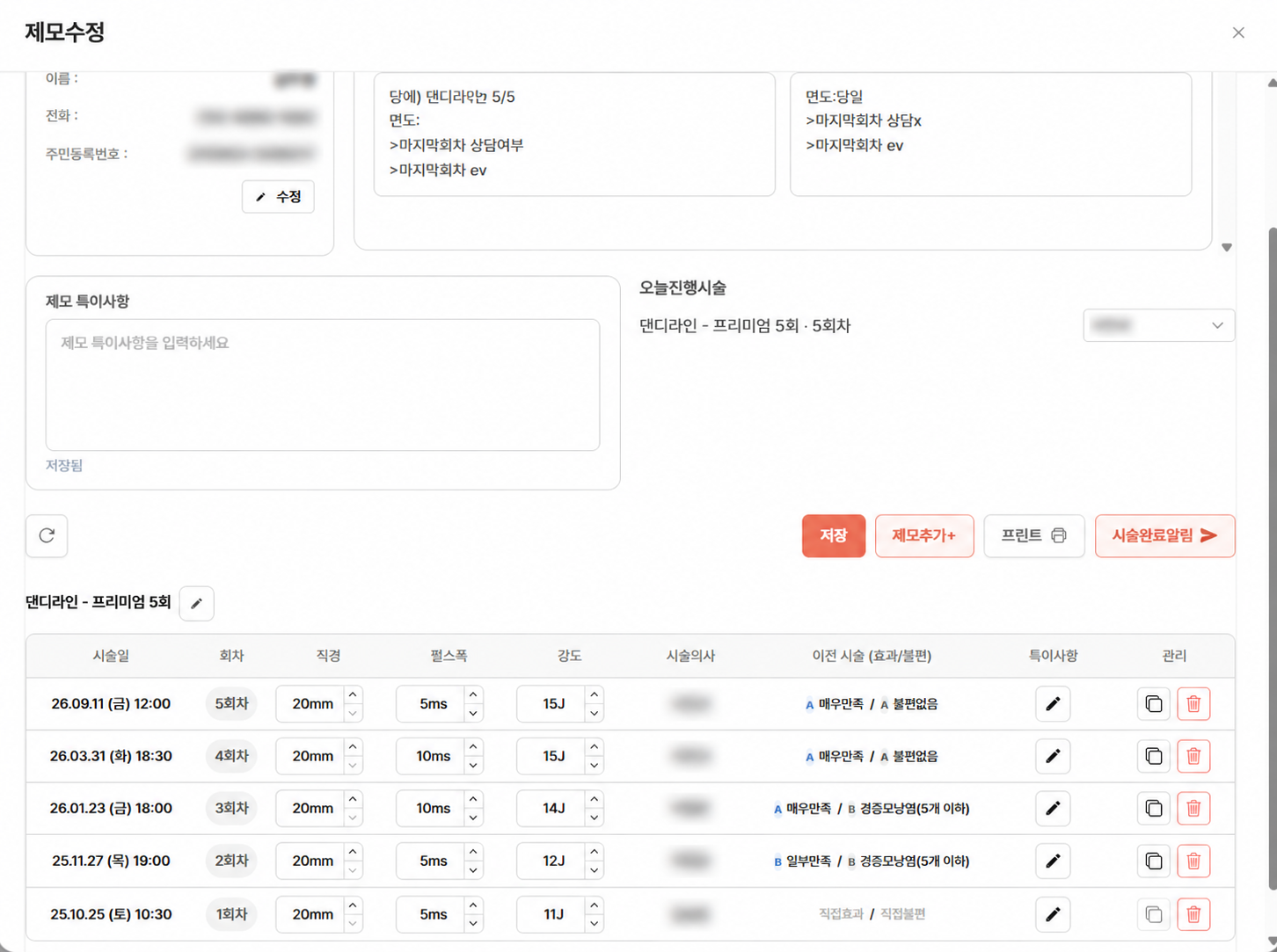 Hair Removal Chart - Diameter, pulse width, intensity per session, and effectiveness/discomfort of the previous treatment (Personal information anonymized)
If you look at the records of the same patient by session side by side
How the diameter, pulse width, and intensity changed according to the cycle,
And at the next visit, you can see at a glance the effectiveness and discomfort of the previous procedure.
The accumulated hair removal records have now exceeded 28,000 cases .
(The analysis of this data is summarized in the previous post , "GentleMax Pro Plus Hair Removal Laser Procedure Report." )
5. The required records vary for each procedure.
Then, I had this thought.
If it is meaningful to structure and manage previous parameters and results in hair removal,
Couldn't the same be done in other procedures as well?
However, it was not possible to write down all procedures in the same format.
This is because what needs to be considered varies for each procedure.
Hair Removal - Area, Parameters, Response, Next Settings
Lifting - Equipment, Shot Count, Floor, Settings by Area
Fillers, Skin Boosters - Product, Dosage, Injection Site, Results
The same applies to pigmentation, Botox, and scar treatments.
So, instead of performing all procedures in the same way and with less effort,
We made the data that needs to be recorded different for each procedure.
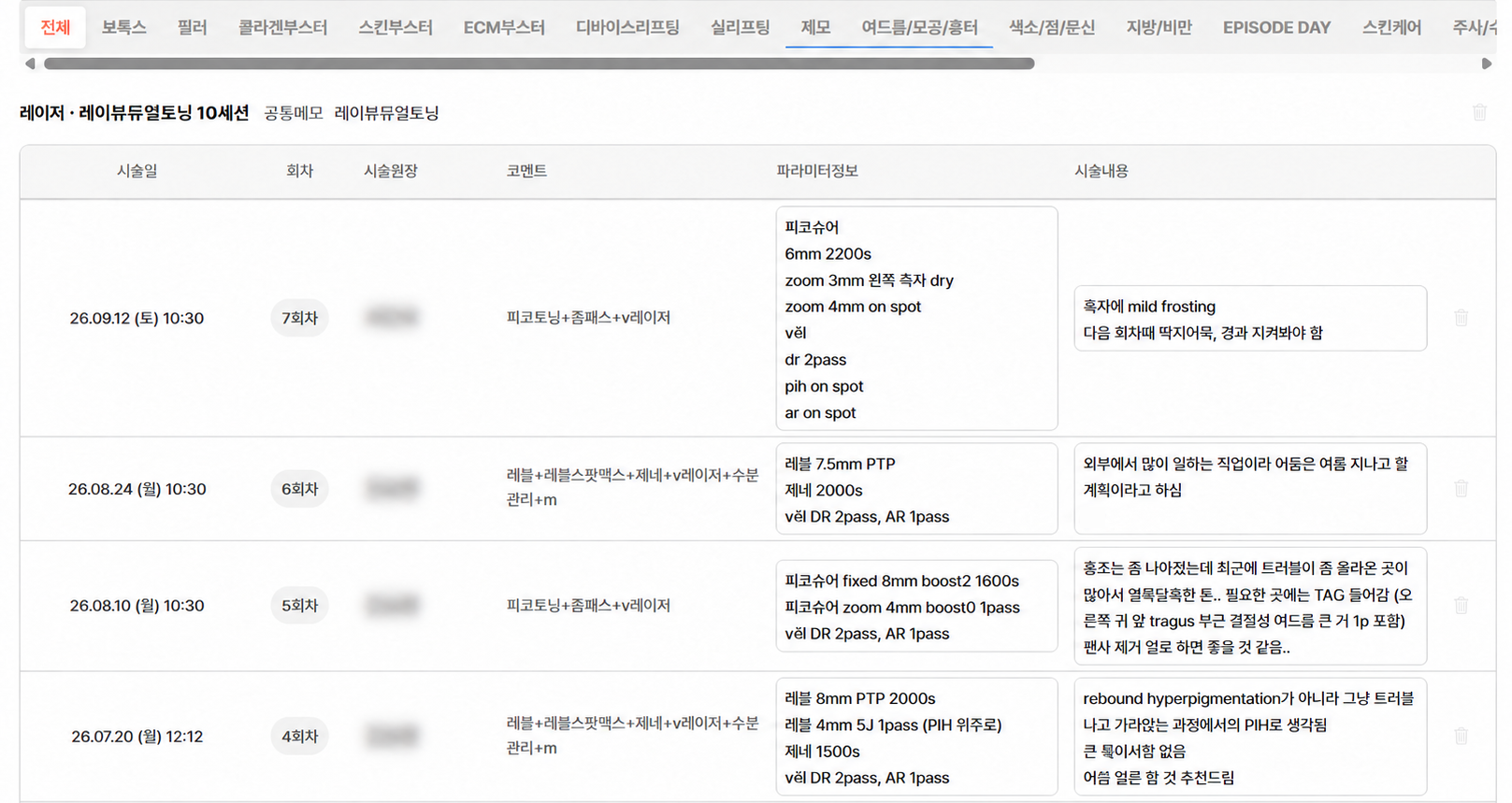 Record of laser toning parameters and treatment details by session (de-identification of personal information)
When viewed collectively like this, you can see the flow of under what conditions the treatment was performed during each session and how the skin reacted at that time.
As a result, I eventually ended up creating the charts myself .
We have optimized it so that it is easy to keep records and you can quickly check only the records needed for the next appointment.
6. Photos are also records.
There is one more thing that cannot be left out of medical records.
It is a photo .
We leave photos in two ways.
Standard Shooting - Shots are taken in the studio at precise angles. Used to view overall changes, such as lifting or volume enhancement.
Simplified Imaging - Photos of a localized area are taken at each session. This is used to observe localized changes such as pigmentation, hair removal effects, and pores.
However, to properly utilize a single photo, there is more work to be done than you might think.
Wash face, move to the shooting room, take the photo, register it in the chart, open the chart again to check,
Only then can it be used for counseling.
The process is too long to repeat every session.
So, we started by simplifying the quick shots that need to be taken frequently.
We take a photo immediately with a pad at the treatment site and compare it directly with the photo from the previous session right after the shot.
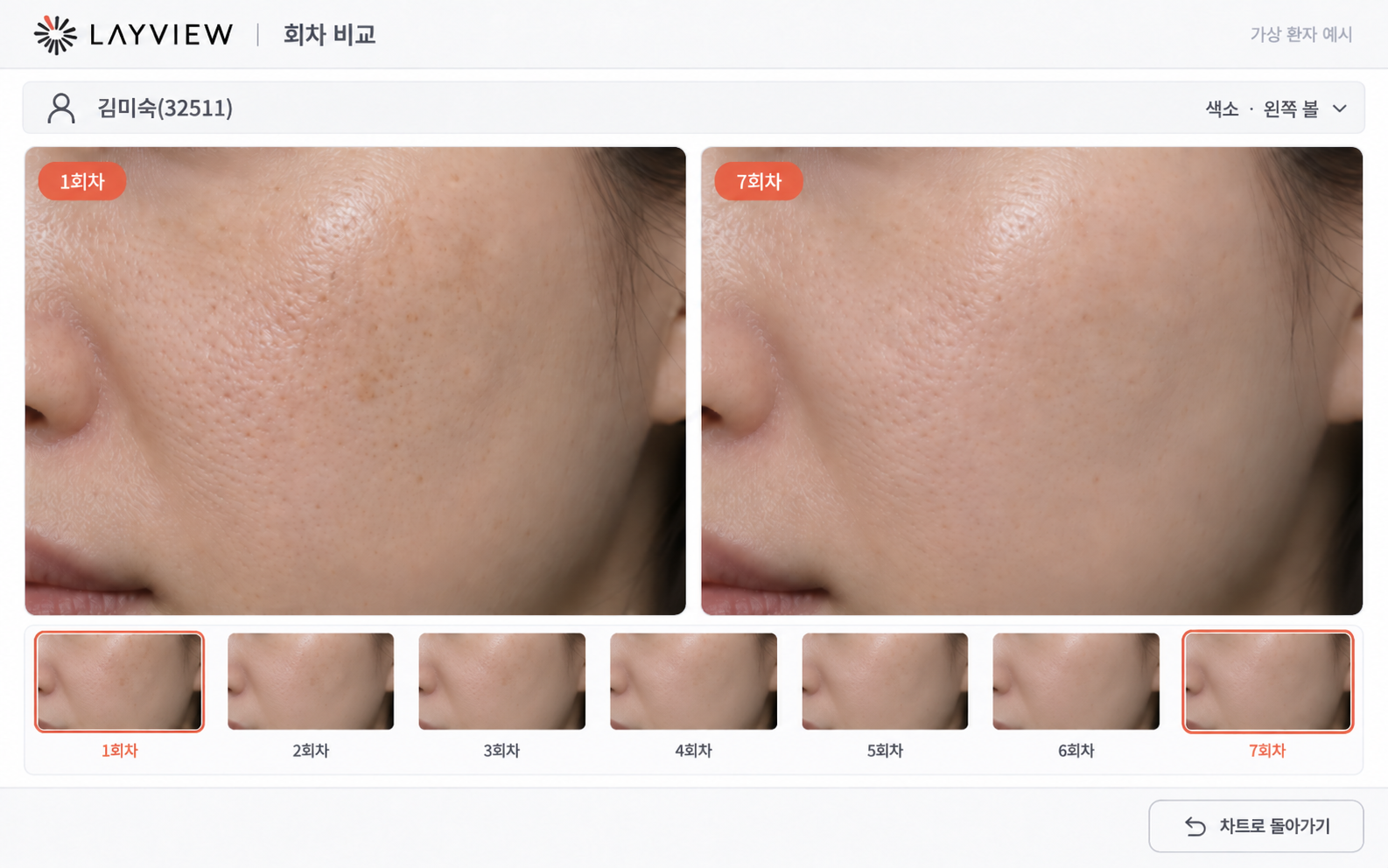 Photo comparison screen by session (virtual patient example)
Rather than saying "it's getting better,"
It is much more accurate to view it side by side with the photo from the previous episode.
7. In conclusion..
To summarize, the reason I am obsessed with records is simple.
This is because even with the same equipment and the same procedure, it is not done the same way for everyone.
What parameters were used last time,
How they reacted after that,
So this time, what to keep and what to change.
This needs to be connected.
Even procedures performed with the same care as the first session every time,
Conversely, you can also avoid procedures that raise the level excessively without knowing the reaction.
I believe that the chart is not just a simple record, but a basis for achieving better results in the next treatment .
So, I will continue to ask, "How was it after your last procedure?" at your next visit.
This is because each and every one of those answers serves as important information to make the next procedure more suitable for me.
This has been Seo Min-ho. Thank you for reading.