


What are the most suitable laser hair removal parameters for Koreans?
This is the reason I started recording hair removal data.
hair removal does not yield the same results just because the same equipment is used.
The results vary depending on the intensity in J, the irradiation angle in mm, the wavelength, and the number of treatment performed.
However, in actual clinical practice , there are fewer instances than expected where these values are systematically recorded to adjust parameters for the next session.
We have recorded the parameters used each time hair removal was performed, and have re-checked the effectiveness and discomfort of the previous treatment at the next visit.
The accumulated records of hair removal treatment have now exceeded 28,000 cases .
This time, I reorganized and analyzed this data.
0. Key points of this analysis
This data includes items called previous effect and previous discomfort.
For example, the satisfaction recorded at the 5th visit is the result felt after the 4th treatment, not the result of the 5th treatment .
So, instead of simply grouping the intensity and satisfaction of the same row,
We reconnected the chart number + hair removal program + session to match the intensity and results of the actual immediate treatment.
In this article , we analyzed only the data from treatment with a diameter of 20mm .
Among them, the data that could be linked to the actual immediate treatment was 8,738 satisfaction cases .
Satisfaction
Very satisfied 5 points / Satisfied 4 points / Average 3 points / Minimal 2 points / None 1 point
The inconvenience is
None 1 point / Mild folliculitis 2 points / Severe folliculitis 3 points / Redness for more than 1 week 4 points / Burn 5 points
It was scored as.
Then, let's look at the results.
1. Does satisfaction increase with higher intensity?
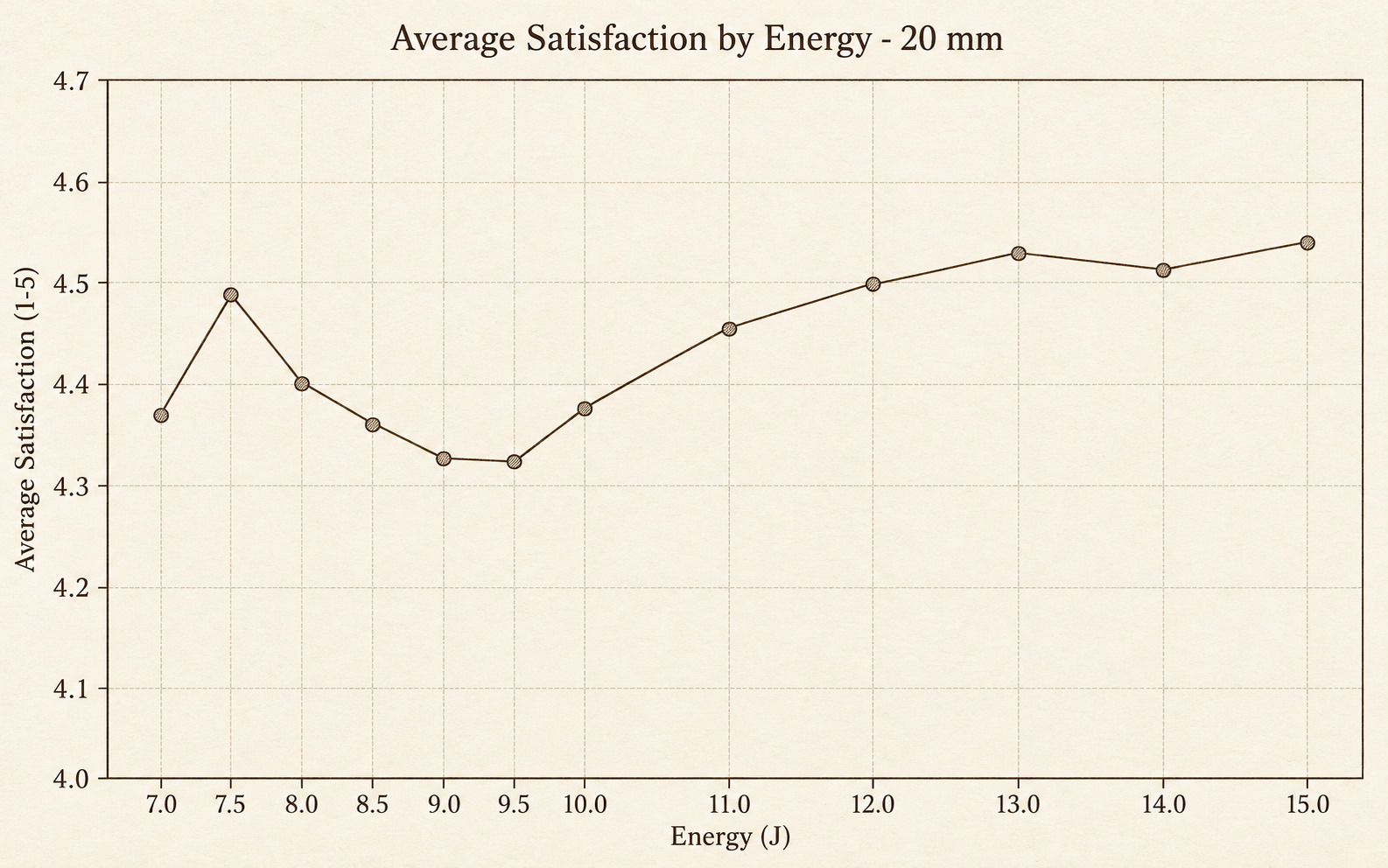 Satisfaction with hair removal treatment based on energy (J)
If you look at the graph at first, it is not a very simple straight line.
Satisfaction levels fluctuate slightly in the 7~9.5J range.
However, from 10J onwards, the flow becomes quite clear.
The average satisfaction at 10J is approximately 4.37
11J is 4.46
12J is 4.50
13J is 4.53
14J is 4.51
15J is 4.54
It was.
in other words,
After 10J, satisfaction generally increased as energy increased, and at 12~15J, a high level of satisfaction of around 4.5 points was maintained.
There is one important point here.
The amount of data in the 7–8J range is relatively small. Therefore, rather than attaching significance to small differences such as 7.5J being higher than 8J, it is more appropriate to look at the overall trend in the 10–15J range where sufficient data has accumulated.
And just by looking at this, right away
You cannot conclude that “15J is the best strength.”
The reason will be revealed later.
2. However, wouldn't increasing the intensity also increase the side effects?
Laser hair hair removal is a treatment that delivers heat targeting melanin.
Therefore, if you think intuitively
Increased intensity → Increased effectiveness → Increased skin irritation and side effects
It is easy to think this way.
However, the actual data was slightly different.
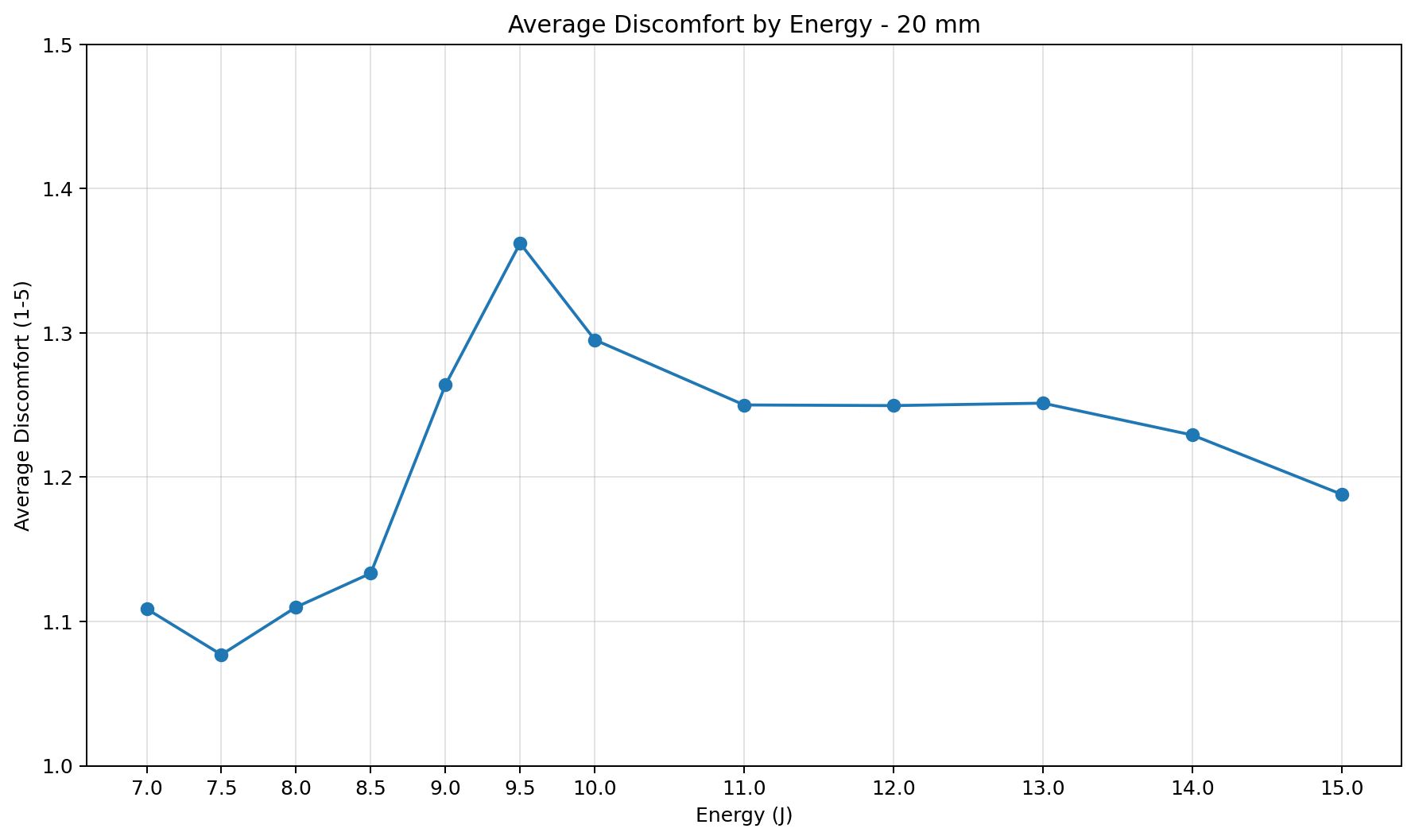 Degree of discomfort according to energy (J)
At 7~8.5J, the average discomfort level was around 1.1.
It goes up a little from 9J
At 9.5J, it was highest at approximately 1.36 , and
After that, it actually decreased again.
10J 1.30
11J 1.25
12J 1.25
13J 1.25
14J 1.23
15J 1.19
To summarize,
In this data, no pattern was observed where discomfort increased as intensity increased.
Rather, the average discomfort level was quite low even in relatively high energy ranges such as 12~15J.
But here
Higher intensity is actually safer.
You should not conclude that.
This is because in actual clinical practice, 13 to 15 J is not used for all patients from the beginning.
The intensity and the number of rounds are interconnected.
We will look at that part again a little later.
2. Are there any side effects hidden by the average value?
There is always a trap in averages.
Even if most patients score 1 and a few show a response of 4 to 5, looking only at the average may not seem like a big problem.
So this time as well, I plotted the actual data point by point.
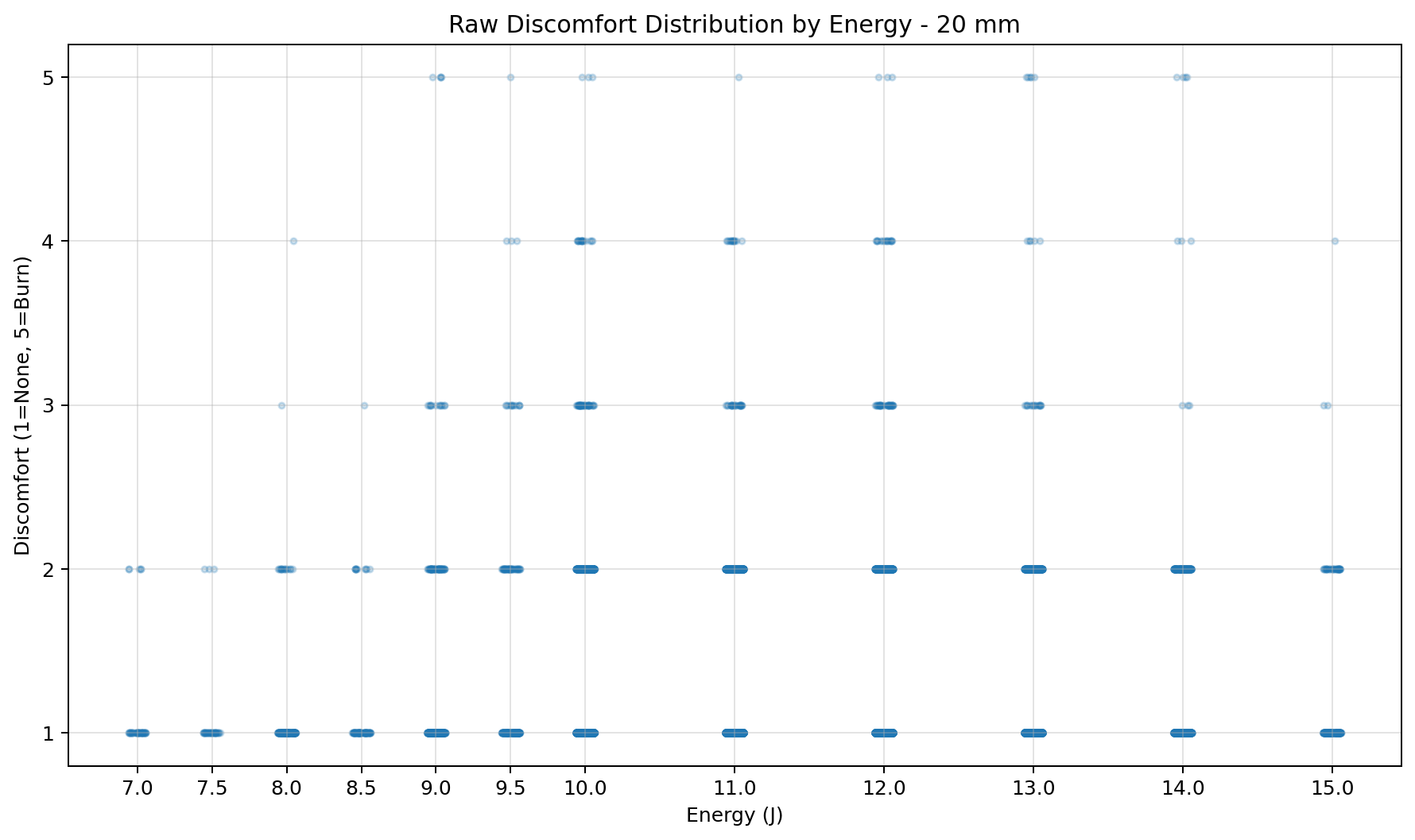 Individual inconvenience data by energy (J)
The vertical axis represents the inconveniences experienced by actual patients.
1 point indicates no inconvenience
2 points is mild folliculitis
3 points is severe folliculitis
4 points is redness lasting for more than one week
5 points is a burn.
Overall, as expected , the data is overwhelmingly concentrated on 1 to 2 points.
Reactions of 3 points or higher are relatively rare, and reactions of 4 to 5 points are even rarer.
And the important point is that severe reactions were not observed to be concentrated only in the high-energy range .
Although some cases of 4 to 5 points are observed between 9 and 14 J, severe side effects do not continuously increase with increasing energy.
in other words,
It is difficult to explain the side effects based solely on “how many joules it was.”
This is because in hair hair removal, various variables such as skin tone, hair thickness and density, number of sessions, wavelength range, and immediate skin reaction all work together.
3. Does satisfaction with hair removal increase with each hair removal?
This time, we will look at it based on the number of treatment sessions , rather than the intensity.
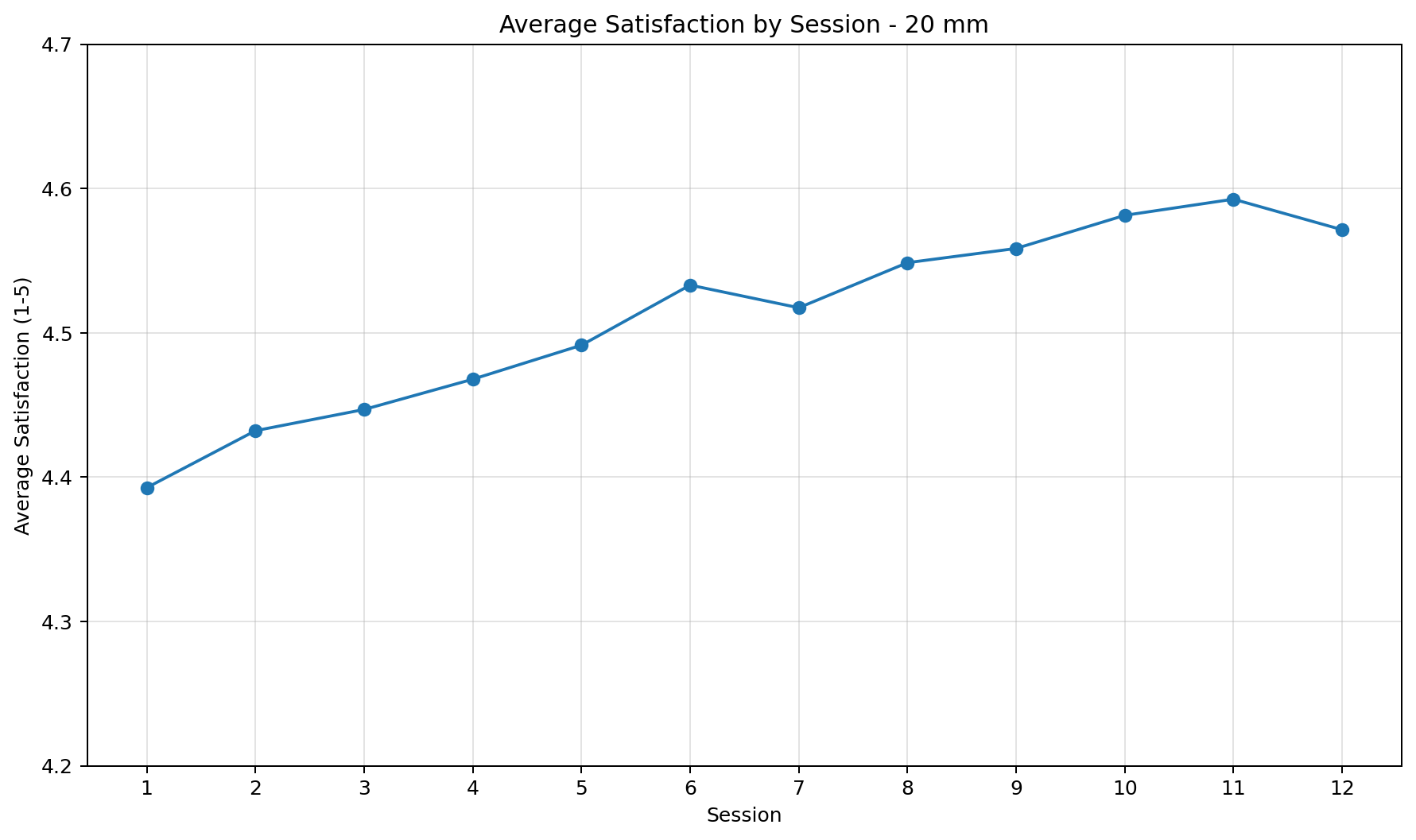 Satisfaction by treatment session
This graph turned out quite nicely.
Average satisfaction for the first session: 4.39
2nd round 4.43
3rd round 4.45
4th round 4.47
5th round 4.49
6th round 4.53
8th round 4.55
Episode 9 4.56
Overall , satisfaction gradually increases as the number of sessions accumulates.
hair removal is not a treatment that ends with a single treatment.
In each session, hair that has entered the growth phase is repeatedly removed, and the thickness and density of the remaining hair also gradually change.
Therefore, it is a clinically natural progression for the overall hair removal effect felt by the patient to increase over multiple sessions.
The satisfaction level for rounds 10–12 rises to 4.58–4.59, but since the amount of data decreases significantly from this point onward, the section I consider meaningful is rounds 1–9, where the sample size is sufficient.
Even in that segment, the upward trend in satisfaction is quite clear.
4. Will complaints increase or decrease if the number of sessions increases?
This time, it is the inconveniences by episode.
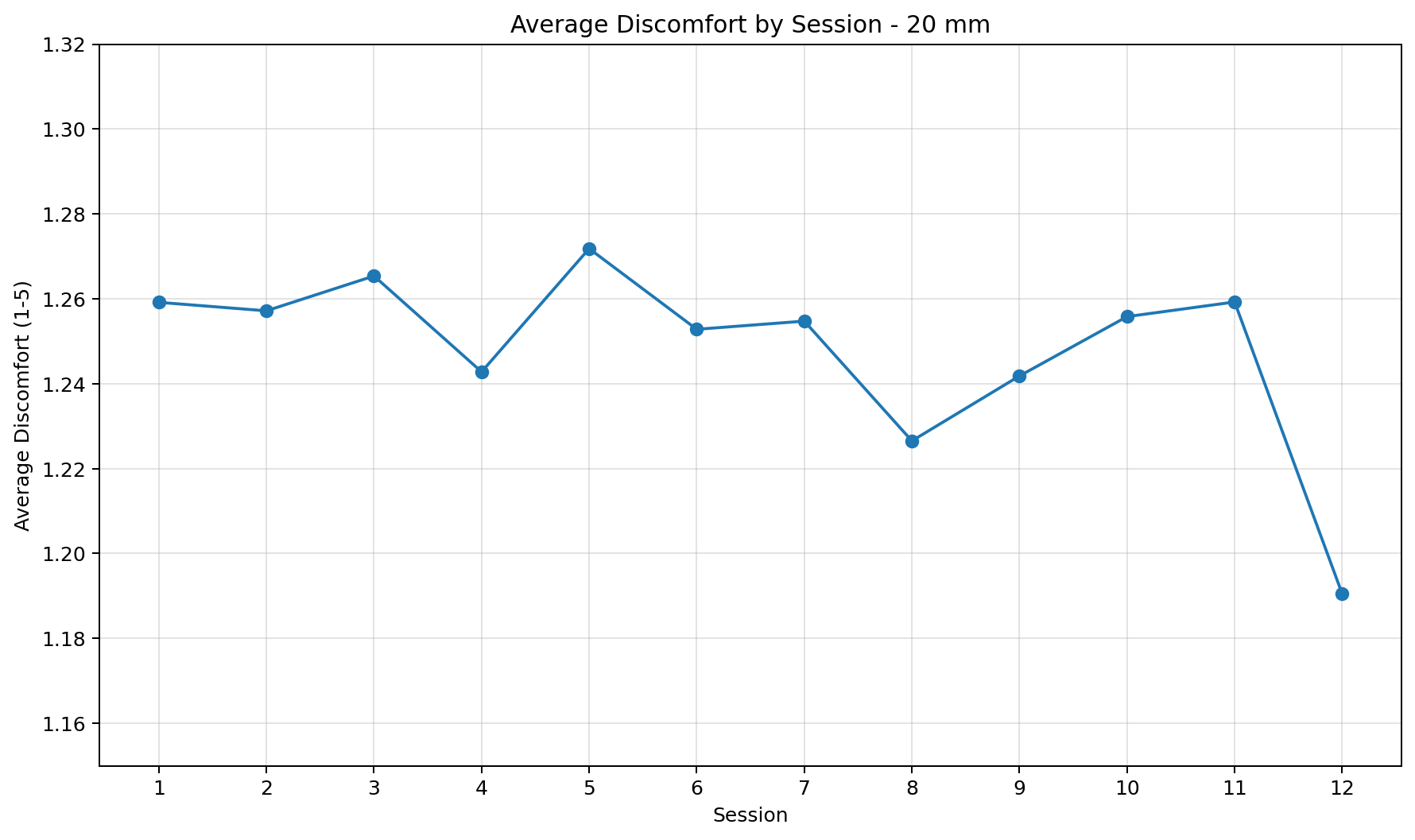 Inconveniences related to the session
This is the part I found most interesting when I first saw this graph.
The average discomfort level for the first round is approximately 1.26 .
However, even after passing through the 2nd, 3rd, 4th, and 5th rounds and going up to the 9th round, it mostly stays between 1.23 and 1.27 .
It is almost flat.
In other words, no accumulation or increase in discomfort was observed as the frequency of hair removal increased.
And this result is meaningful only when viewed in conjunction with the intensity graph that follows.
This is because, in fact, the energy we use increases significantly as the episodes progress.
5. In which round did severe side effects occur?
Instead of just looking at the average, I verified the actual data as points again this time.
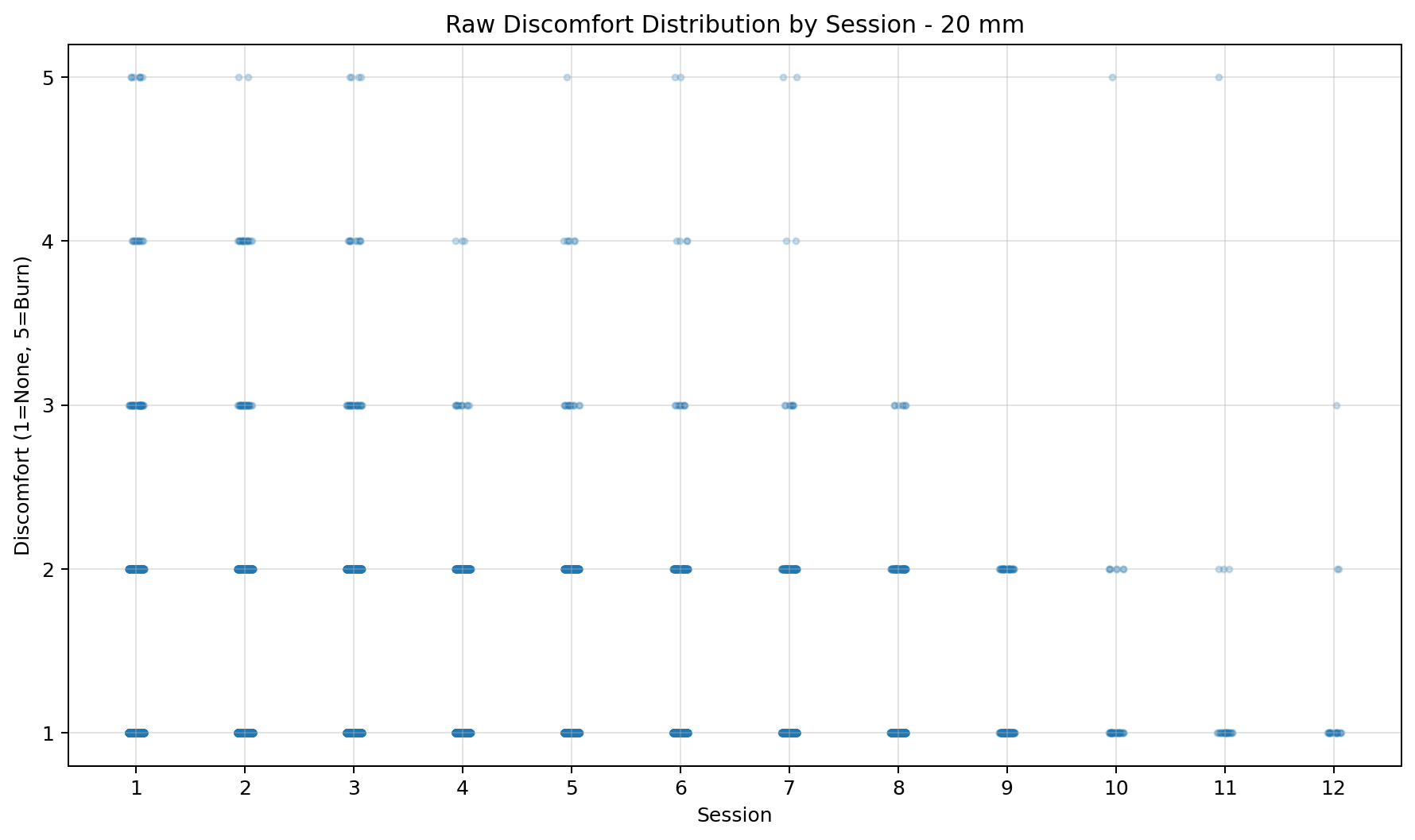 Inconveniences by session
Even in the 1st to 3rd rounds, most are 1 to 2 points.
However, reactions that may cause inconvenience in real life, such as 4 or 5 points , are relatively more noticeable in the early rounds.
As the playthrough progresses, these aspects also appear to diminish.
However, there is something to be careful about here as well.
As the number of rounds increases , the decrease in the number of points may be partly due to a reduction in the sample size, as the number of patients itself decreases.
Therefore, using only this graph
Since it is an early episode, burns occur.
We cannot conclude that there is a causal relationship.
However, the reason why the initial session is important during the actual treatment is clear.
At first, we do not yet fully know the patient's exact laser response.
Even if they appear to have the same skin tone, the actual hair density, thickness, heat response, tendency toward folliculitis, and pain sensitivity are all different.
Therefore , I believe it is important to adjust the parameters for subsequent sessions while monitoring the response, rather than starting with an unconditionally strong intensity from the first treatment.
6. The most important graph in this data
The last part is the actual usage intensity by session .
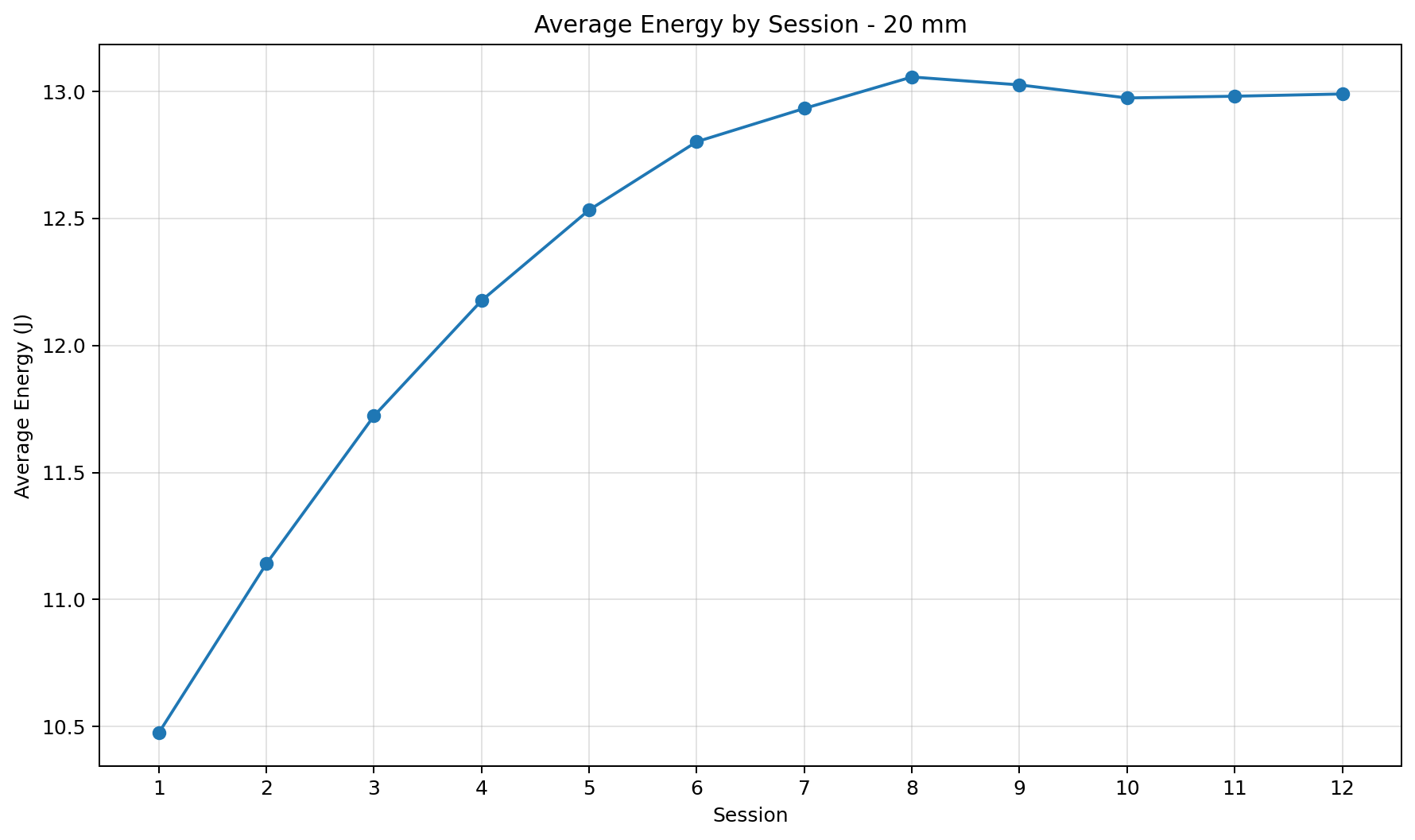 Laser intensity according to session
If you view this graph together with the previous satisfaction and inconvenience graphs, you can see the most important core of this analysis.
The average intensity of the first session is 10.48J .
2nd round 11.14J
3rd round 11.72J
4th round 12.18J
5th round 12.53J
6th round 12.80J
7th round 12.93J
8th round 13.06J
After that , it remains almost constant at around 13J .
In other words, in our actual hair removal data
A pattern was observed in which the intensity started at a relatively low level initially, was gradually increased while checking the effects of the previous treatment and skin response, and then maintained once a certain level was reached .
And in that process
Satisfaction increased from 4.39 to 4.55 or higher ,
The average discomfort level remained around 1.2 .
I think this part is the most important in this data.
7. Ultimately, the important thing is not ‘how many J is best?’
When I first started this project, I was curious too.
“What is the best hair removal intensity for Koreans?”
However, as I looked at over 28,000 records, my curiosity changed a little.
Rather than finding a single number that applies to everyone,
It was much more important to record what parameters this patient received treatment with last time, how effective they felt, and what kind of reaction occurred on their skin.
The results shown by this data can be summarized as follows.
After 10J, satisfaction generally increased as energy increased, and high satisfaction was maintained at 12~15J.
No pattern was observed where discomfort increased along with an increase in energy.
As the number of sessions accumulated, average satisfaction increased, but average discomfort remained almost constant.
The actual treatment intensity started at about 10.5J during the first session, gradually increased to about 13J by around the eighth session, and then stabilized.
Ultimately, what is important in hair removal is
It is not about making it strong from the start, nor making it unconditionally weak.
Leaving a record of the previous episode,
Check the results,
Next, adjusting the treatment.
I believe that hair removal is not a ' treatment performed exactly the same way every time,' but rather a treatment where parameters must accumulate as the sessions progress.
So, in the EPISODE, parameters are recorded every time a hair removal treatment is performed.
We check not only how many J, how many ms, and what diameter was used, but also the actual effect and discomfort again at the next visit.
As that record accumulates, you can perform safe and effective treatment.
8. In conclusion..
I have prepared Part 4 for the first time in a while.
I have heard that while there are many patients reading this, many directors are also reading it.
This analysis is based on retrospective observational data accumulated during actual clinical practice at a medical institution . As this is not a randomized clinical trial, it does not imply a causal relationship suggesting that higher energy is safer or that a specific energy level is best for everyone. Other variables, such as skin tone, hair condition, and wavelength range, may also have an influence.
I will conclude this post hoping that this information has been of some help to you for a safe and effective treatment.
I will be back with more data next time.
This has been Seo Min-ho. Thank you for reading.
All articles and data analyses were written and conducted personally by Seo Min-ho .