



GentleMax Pro Plus hair removal Parameter Guide
The first part of a three-part hair removal series.
The parameter guide delves into everything about laser hair removal parameters, not just intensity (J).
 hair removal treatment scene
0. "How many lines does it take?"
The question above is the one most frequently asked by those who have looked into hair removal treatment to some extent.
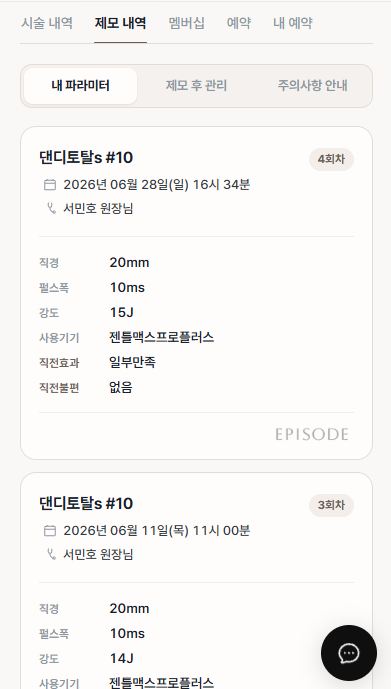 My personalized hair removal card that I can view anytime, anywhere
At our hair removal , we record all parameters during hair removal procedures and check satisfaction and any inconveniences from the previous session, sending them to your mobile phone so you can view them comfortably at any time.
And... there is the most important reason why I started this.
This is precisely to scientifically gather data to definitively organize the 'parameters for hair removal lasers' that everyone is curious about ( I will reveal them in the next post !!).
First, the five major parameters of the laser are as follows.
1. Wavelength
2. Pulse width (pulse duration)
3. Diameter (spot size)
4. Pulse interval
5. Influence
Shall we take a closer look at each one?
Since it is complicated to list information on all lasers, I will write this post focusing only on laser parameters related to hair removal !
1. What is wavelength (nm)?
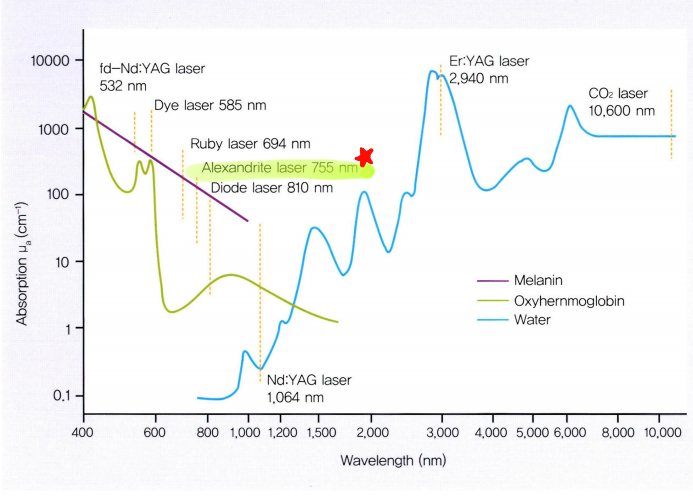 Source: Parameters and Selection of Skin Lasers, by Lee Jae-dong
"Why 755nm?"
There are various wavelengths used for hair removal, such as 755nm, 810nm, and 1064nm, but
We prefer 755nm the most. This is because it responds most selectively to the melanin pigment targeting the beard.
(In the figure above, the absorption rate of purple melanin pigment is high between 600 and 800. Although the ruby laser has higher selectivity, its short wavelength makes it difficult to penetrate the skin layer where hair follicles are located, so the most ideal wavelength is 755nm.)
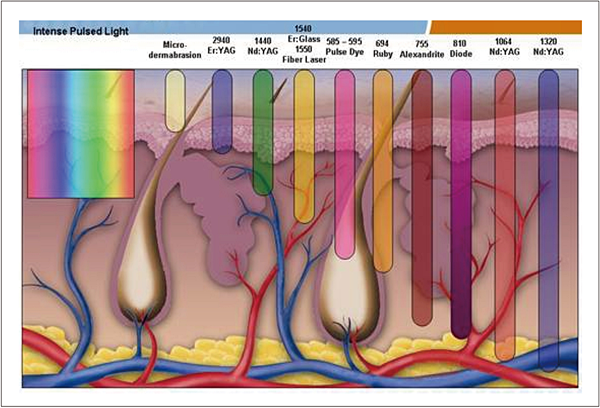 Below 1200nm, the higher the wavelength, the deeper the penetration depth. Source: dailyvet
Although 1064nm is sometimes used for deep beards, the 755nm wavelength provides the most stable and excellent results, and most hospitals use this wavelength.
2. What is Pulse Width (ms)?
Simply put, pulse width refers to the length of the time unit during which the laser is emitted, and commonly used pulse widths include 2ms, 3ms, 5ms, 10ms, and 20ms.
Why is pulse width important?
Each laser target has a specific target pulse width (known as TRT, which refers to the time it takes for heat to diffuse and spread after being heated by the laser. If the laser is applied for longer than this time, unwanted side effects may occur, and if it is too short, the desired effect may not be achieved...! It is complicated, so I will skip it in the hair removal explanation..)
Simply put, due to this principle, it is better to use a shorter pulse width for thinner hair and a longer pulse width for thicker hair.
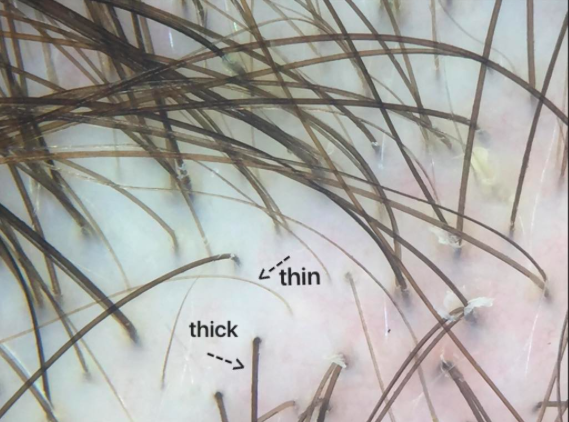 Even within the same area, the thickness of the hair and the thickness of the hair follicles vary.
Generally, thin hair has shallow roots and thick hair has deep roots, but there are cases where this is not the case. A typical example is areas where the hair is not particularly thick but does not fall out no matter how many times laser hair removal hair removal are performed. Such hair can be removed quickly by using a longer pulse width.
"Then, if you unconditionally lengthen the pulse width, won't all the hairs react?"
As the pulse width increases, the energy value per ' unit time ' decreases when the same amount of energy is input. (In other words, when the area below is the same (i.e., when shooting with the same energy), the peak power increases as the time decreases.)
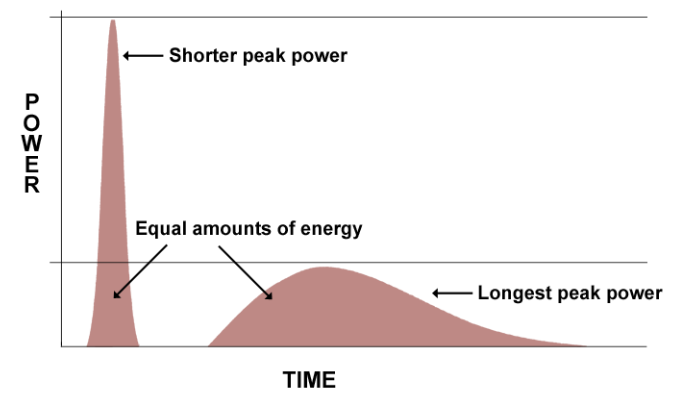 As the pulse width decreases, the peak power increases.
Therefore, the pulse width should not be infinitely long, and the appropriate irradiation time for hair removal is in the range of 2ms (very thin hair) to 20ms (very thick hair).
3. What is diameter (mm)?
What is the most ideal diameter for facial hair hair removal?
The commonly used diameters are 18mm, 20mm, and 24mm.
The advantage of a narrow diameter is that it allows for detailed treatment in every nook and cranny. (It is the same principle as being able to sweep up every corner with a small broom.)
The advantage of a wider diameter is that the laser can penetrate deeper, and the treatment time is faster.
On the other hand, the disadvantage of a narrow diameter is that the laser cannot penetrate to a sufficient depth.
The disadvantage of a wide diameter is that, due to the characteristics of the face with its many curved surfaces and structures (eyes, nose, mouth, etc.), using a diameter that is too wide makes it difficult to cover the entire area.
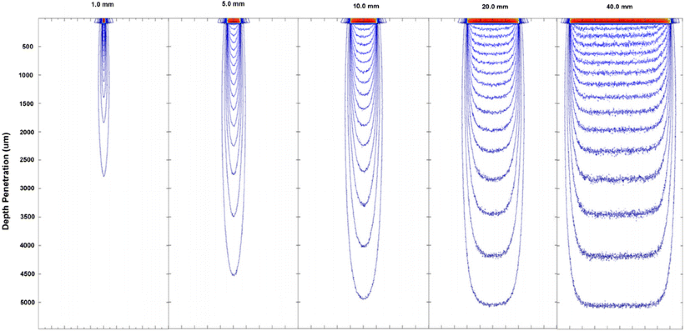 Difference in penetration depth according to laser diameter (Source: Ash, C., Dubec, M., Donne, K. et al. Effect of wavelength and beam width on penetration in light-tissue interaction using computational methods. Lasers Med Sci 32, 1909–1918 (2017). https://doi.org/10.1007/s10103-017-2317-4)
This is a famous paper. It indicates that from a laser diameter of 20 mm , there is almost no difference in penetration depth even if the diameter increases further.
In other words, with 18mm, the treatment time is longer, so the time spent feeling pain is also prolonged, and with 24mm, it is difficult to cover every nook and cranny of the entire area .
In that case, 20mm is the most ideal.
24mm is recommended for body hair hair removal. For the body, which has few structures to worry about, a wider diameter is preferred as it allows for a wider laser penetration range and reduces treatment time.
4. What is the irradiation interval (Hz)?
The irradiation interval is how many times the laser is emitted per second.
It is practically the least important parameter among the hair removal laser parameters.
Most are 1Hz to 2.5Hz and do not significantly affect the results.
5. What is Intensity (J)?
How many lines is it? The reason why the question is a half-baked question
This is the core parameter of hair removal lasers and a parameter that many people are curious about.
To start with the conclusion, the higher the intensity, the greater the hair removal effect , and the more side effects there are The risk also increases.
Therefore, to achieve maximum effectiveness and minimal side effects from laser hair treatment, selecting the most suitable intensity is of the utmost importance.
However, you should not look at this figure alone regarding intensity.
As the diameter increases, the overall strength increases, so the strength must be lowered, and
As the pulse width decreases, the maximum intensity increases, so the intensity must also decrease.
" As the pulse width decreases, the peak power increases."
I will explain this in more detail through the graph below.
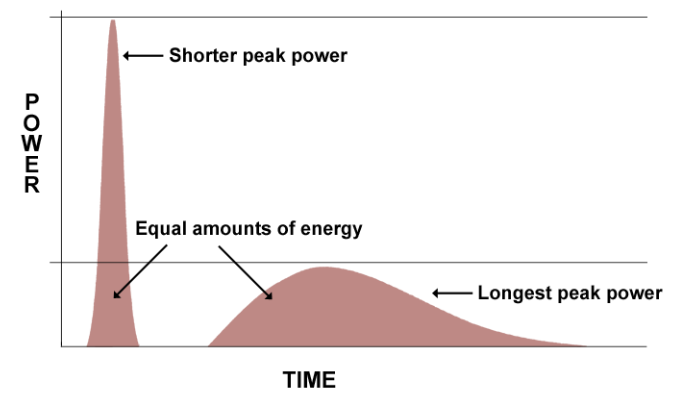 As the pulse width decreases, the peak power increases.
Even with the same intensity (Fluence, J/cm^2), if the pulse width increases, the area value remains the same, so the power on the y-axis increases.
In other words, when the pulse width is short, the intensity must be lowered, and when the pulse width is long, the intensity must be increased.
(So, for thick hair, you have to increase the pulse width to target large follicles, and since the peak power decreases accordingly, you have to increase the intensity... It's complicated, right? ^_ㅠ)
As the diameter increases, the total energy increases.
The reason is that the unit of laser intensity is J/cm².
Since it represents energy per unit area, the total energy increases as the area increases at the same intensity.
The guideline table below also states that under the same conditions, the intensity should be set lower as the diameter (spot size) increases.
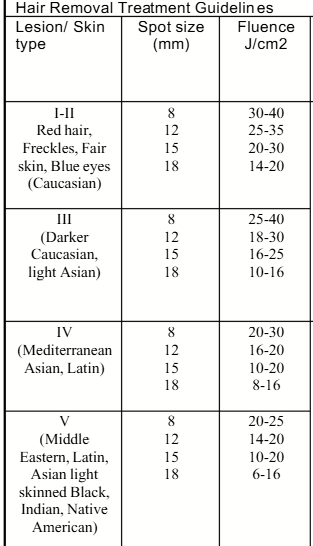 Rough guidelines. Why was it written only roughly?
The guidelines above do not specify a precise value for fluence but rather list it as a range. What is the reason for this?
Since the parameters vary depending on the condition of the hair and skin,
This is because skilled hospitals must proceed with higher intensity and personalized parameters than this.
This is the reason why hair removal efficiency is low when performed with the same intensity.
In addition, it is officially stated that you should observe the skin's reaction to the hair removal laser during the first treatment and gradually increase the intensity .
The selection of hair hair removal laser energy depends on hair condition, skin condition, and the presence or absence of side effects.
A comprehensive assessment must be made regarding the parameters of energy, diameter, and irradiation time.
So far, I have explained the GentleMax Pro Plus hair removal laser parameters that many of you have been curious about.
In the next post, I will explain the hair removal card , which is the most important part of our clinic , and
I will tell you about the ideal hair removal treatment based on the data accumulated through this hair removal card .
If you have any questions, please leave a comment, and I will answer them in detail.
Thank you for reading this far.