



GentleMax Pro Plus hair removal treatment Complete Summary (Final)
A series summarizing everything about laser hair removal
This is the final part, Part 3.
If the previous two posts were difficult to read, this time
Easy explanations are provided along with real-life examples.
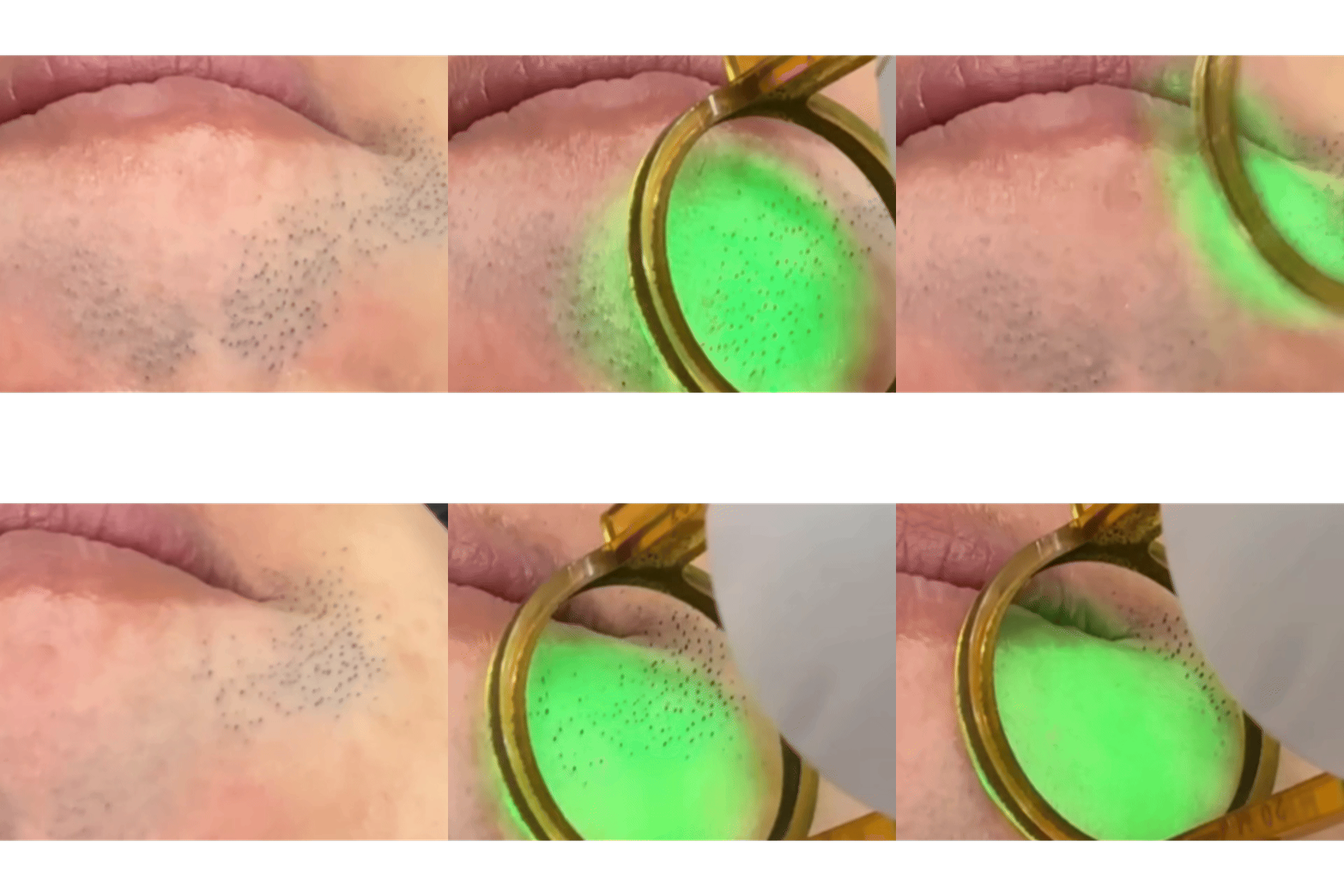
First, a hair removal treatment scene that looks refreshing just by looking at it.
I will take a look.
Hello, I am Director Seo Min-ho .
This is the third and final installment of the hair removal series!!
In Part 1 The Truth About hair removal ParametersI will tell you about,
In Part 2, the analysis of the treatment results Over 10,000 casesI posted based on this.
In Part 3, the actual treatment method,
I will approach the desirable hair removal method more easily by looking at before and after photos.
(The content of the last two posts might be a bit difficult, so you can just read Part 3!)
1. Factors to Consider Before hair removal
Factors to consider before starting hair removal
There are a total of three.
Hair thickness, density, skin tone
1) Hair thickness
Hair thickness varies.
The thicker the hair, the larger the size of the hair follicle, and
As explained in Part 1, you must make the laser pulse width long.
Also, the worst thing about it being thick is... it hurts more.
That is why hair removal is much more painful for men compared to women.
As hair removal progresses, the hair tends to become progressively thinner.
Also, since hair thickness varies even among the same person, the pulse width is not fixed.
Sometimes, I shorten the pulse width to focus on trimming fine hairs,
In some cases, it is best to extend the pulse width to catch a few thick strands of hair that do not fall out easily.
(You can think of it as the principle that while we mainly use a vacuum cleaner when cleaning, we also need a wet mop and a brush to clean crevices.)
2) Hair density
Hair density indicates how dense the hair is.
A characteristic of people with high hair density is that even after shaving, stubble remains hazy like a dark cloud.
When hair density is high, increasing the intensity transfers thermal energy to adjacent hair follicles, so burnincluding side effectThe probability increases.
Therefore, hair density is an important factor when adjusting strength.
3) Skin tone
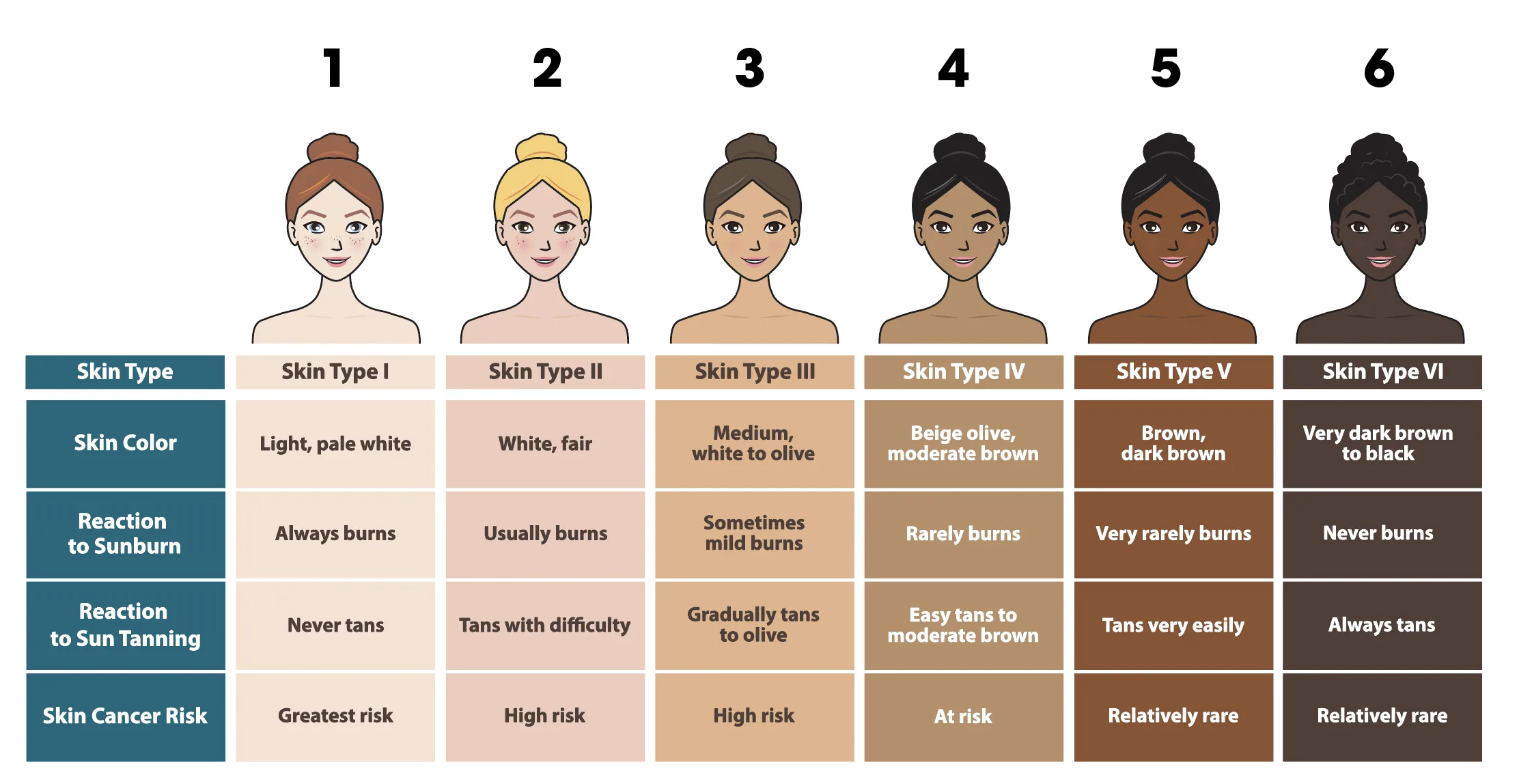 Fitz-Patrick scale. A chart that divides skin tones into six categories.
It is very difficult for Hispanics and Black people belonging to skin types 5 and 6 above to receive hair removal.
(The principle of the laser is to target the black pigment in the hair, and since the melanin pigment in the skin is also black, they react together...)
Most Koreans fall into skin types 3 or 4, so it is generally possible, but occasionally, those who have been tanned cannot receive hair removal.
The darker the skin tone, the more thermal energy is transferred to normal skin tissue rather than the hair, which is our target.
To reduce side effects, the intensity must be reduced.(It is most ideal to gradually increase the amount while observing the skin reaction)
2. Factors improved by hair removal
Now, the factors that improve with hair removal are also total ThreeThere is.
Hair thickness, density, and growth rate
1) Hair thickness
These are the factors to consider when starting the hair removal explained above, and This is the thickness commonly included in the improved elements.
As hair removal treatment are repeated, the hair naturally ThicknessIt becomes thinner Accordingly, the intensity must gradually increase.
2) Hair density
Hair density is also a factor to consider and improve during the treatment.
Therefore, gradually, the hair's densityIt decreases, and the intensity must also become stronger.
3) Hair growth rate
People shave once a day, and those with thick beards shave twice a day.
However, as the hair removal treatment progresses, the growth rate gradually slows down.
(To be precise, beard hairs whose roots have already been destroyed do not grow any further, and since hairs in the resting phase grow much later, it does feel like they grow late.)
Eventually, it becomes to the point where shaving once every 1 to 2 weeks is barely noticeable.
The war with shaving every morning...
Even when still half-asleep, everyone has likely experienced a cut, irritation after shaving, and the struggle with folliculitis at least once.
You can be freed from this pain by receiving hair removal.
3. Actual before and after photos of the treatment
The photo below is a 100% real, unedited photo, and the subject has given their consent.
1) Those who have received 8 hair removal treatment


It started with a diameter, pulse width, and intensity of 20 mm, 5 ms, and 12 J, respectively.
They were very satisfied with the progress of each treatment , and
I did not aggressively increase the intensity because I had mild folliculitis after the treatment .
From the 5th session onwards, noticeably thinning hair was visible, so I reduced the pulse width to focus more on targeting the thin hair.
From the 8th session where the body part changed, My hair volume has decreased, and the folliculitis has disappeared. You can check.
Below is the result photo. (The photo was taken before the treatment , so this is after the 7th session.)
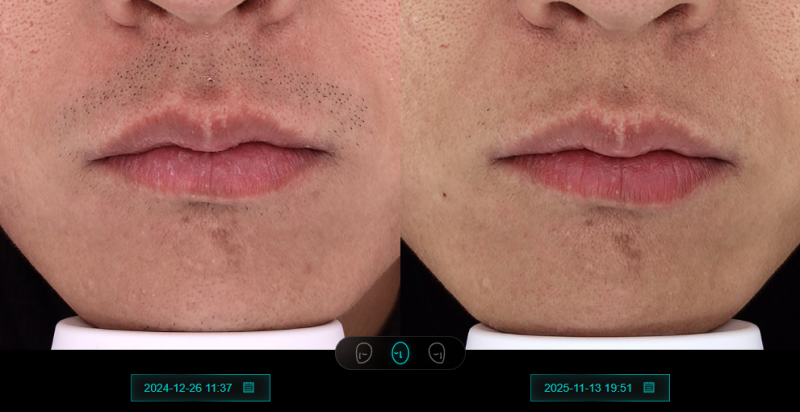 Before and after the 7th hair hair removal ( front view)
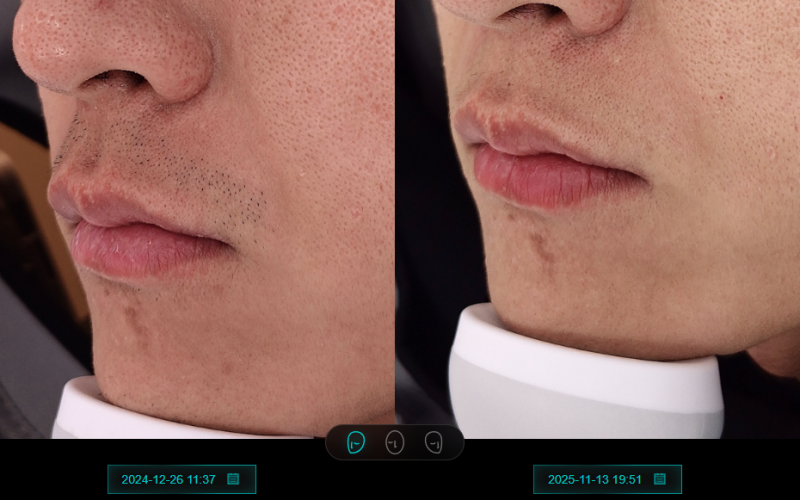 Before and after the 7th hair hair removal ( side view)
2) Those who have received 5 hair removal treatment-1

I was worried that there would be a high chance of developing folliculitis because the patient had existing skin problems around the mouth.
but Cooling and AftercareYou did a great job, so I didn't feel much inconvenience.
*For reference, this is a Teto man who does not want anesthesia.*
We proceeded by gradually increasing the intensity in accordance with the decreasing hair volume.
This is the result photo. (Since the photo was taken before the treatment , this is the photo after completing the 4th session.)
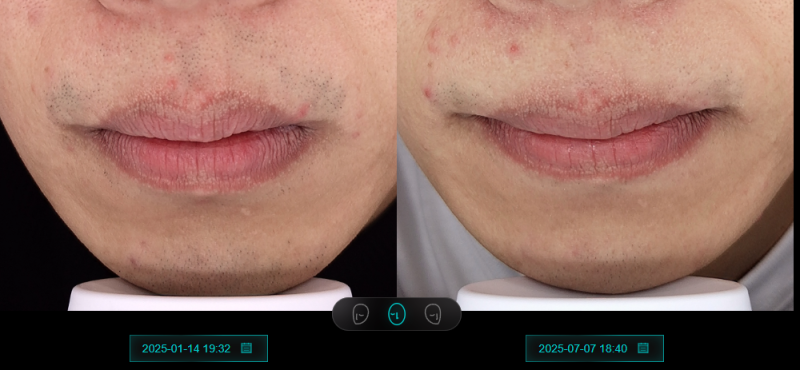 Before and after the 4th hair hair removal ( front view)
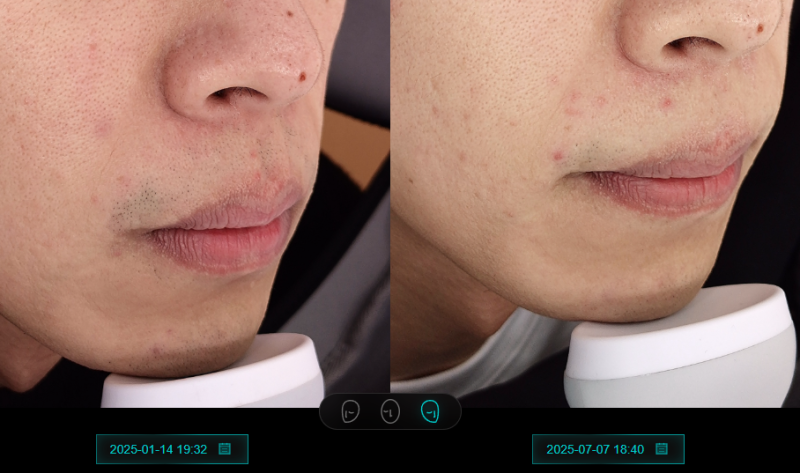 Before and after the 4th hair hair removal ( side view)
3) Those who have received 5 hair removal treatment-2

There are no specific issues, so we will start at a normal intensity.
However, there is a period during which it is maintained due to folliculitis in the middle.
At the 5th diagnosis, the corners of the lips deeply embedded hairThis remains, so to suit it pulse widthWe raised it further and proceeded with the treatment.
This is the result photo. (Since the photo was taken before the treatment , this is the photo after completing the 4th session.)
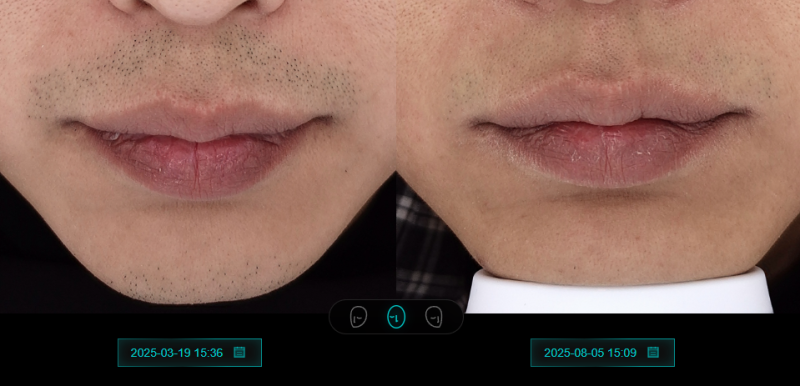 Before and after the 4th hair hair removal ( front view)
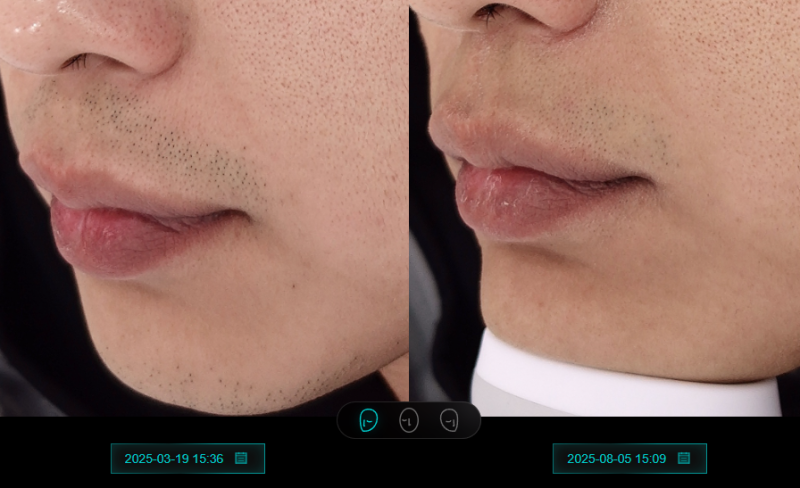 Before and after the 4th hair hair removal ( side view)
As shown in the example, every time Hair conditionand side effectYou must check and adjust the parameters It is definitely effectiveWhile giving,
Minimize side effects hair removal treatment can be performed.
4. Q&A
Now, I will answer the frequently asked questions.
If you have any additional questions, please leave them in the comments, and I will answer them personally in detail.
Q1. Is laser hair removal hair removal permanent?
The answer to this is, first of all, NO. This is because hair does not grow back from hair follicles destroyed by a hair removal laser, but Apart from this, men's beards grow continuously throughout their lives New It comes into being and grows.
To give a simple example, if you look at the beards and mustaches of grandfathers, you can see that they keep growing.
Another example is that compared to adolescence when facial hair first starts to grow, as you enter your 20s and 30s, the facial hair gradually... Things that become thicker and more abundantYou can feel it directly.
However, since all of this is caused by the influence of male hormones, I actually
I explain it by saying that the time when new hair is constantly growing is when they are healthy..! Hahaha.(Nothing in the world has only downsides!)
Q2. When should I shave before hair hair removal ?
That is a good question. First of all, the answer is 'Right before the treatment as much as possible' no see.
When lasers for hair removal were first introduced, optimized parameters were not even defined, and
Since the laser output was also weak, the predominant method involved letting the hair grow first and then transmitting the laser energy along the hair to destroy the hair roots.
However, as the parameters for lasers intended for hair removal are gradually established,
As the laser output increased, there was no longer a need for beard hair grown on the skin.
(The melanin pigment in the hair follicles within the skin and some of the hair extending above them is sufficient for a reaction.)
The reaction is so strong that immediately after the treatment , the hairs inside the follicles instantly pop out to the surface of the skin like popcorn.
(This is called the pop-out phenomenon. It is explained in more detail in Q5 later.)
Furthermore, having a long beard actually increased the pain, caused it to burn and smell worse, and resulted in nothing but disadvantages.
therefore 'Right before the treatment as much as possibleIt is recommended to shave.
Q3. When should I shave after hair hair removal ?
When to hair removal varies from one day to one week depending on individual hair condition. The average is 5 days no see.
Shaving is based on the principle of cleanly cutting well-aligned hair with a sharp blade.
However, because the hair is denatured immediately after the treatment by the powerful laser, it is not cut cleanly but gets caught in the middle.
If you forcefully shave the hair at this time, it can cause skin injuries and bleeding.
Therefore, the most recommended method is to try shaving lightly after 3 days, and if it doesn't work, give up.
I also recommend trying again the next day. (Usually, you can shave by about the 5th day.)
One thing to keep in mind is that you absolutely!!!! must not push by force.
Q4. How many times do I need to get clean hair removal?
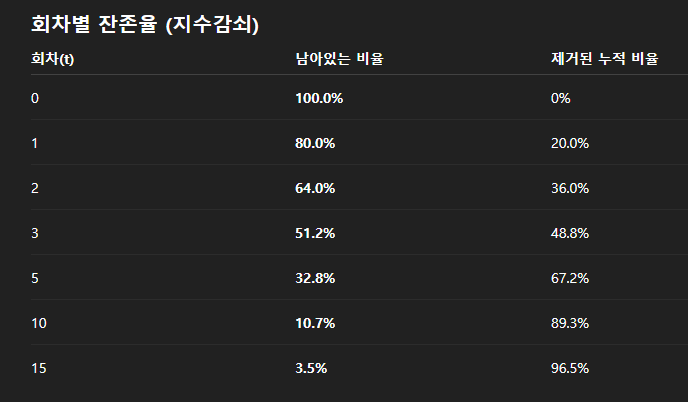
Generally, the percentage of hair that responds to a single hair removal session is about 10–30%.
Assuming 20%, the exponential decay figures are as follows:
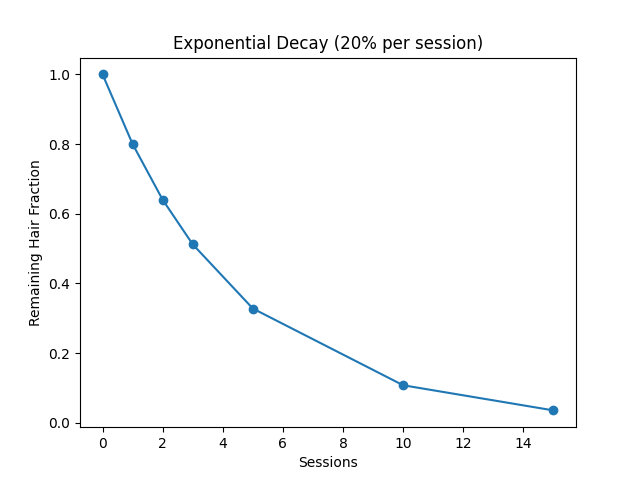
This can be represented graphically as follows.
in other words,
5th time medication during the treatment 70% reduction effectYou can expect,
10th time During the treatment 90% reduction effectYou can expect and
15th time During the treatment Over 95% effectivenessYou can expect.
Q5. I think I grew more facial hair (or white hair) after hair removal .
If you feel that your beard has grown back darker after hair removal , it is highly likely due to 'popping-out,' a reaction that occurs immediately after the treatment .
When a high-intensity laser reacts properly with the hair
1) Melanin in hair absorbs energy
2) Internal moisture in the hair instantly vaporizes to over 100°C
3) Micro-explosion (steam explosion) occurs inside the hair follicle
4) Hair flies out due to the impact
This phenomenon is called popping-out.
You might wonder if it is dangerous since moisture evaporates at over 100°C,
This temperature is applied for a very brief time of less than 10ms, so only the hair follicles are destroyed with almost no skin damage.
In fact, this reaction is the key to laser hair removal.
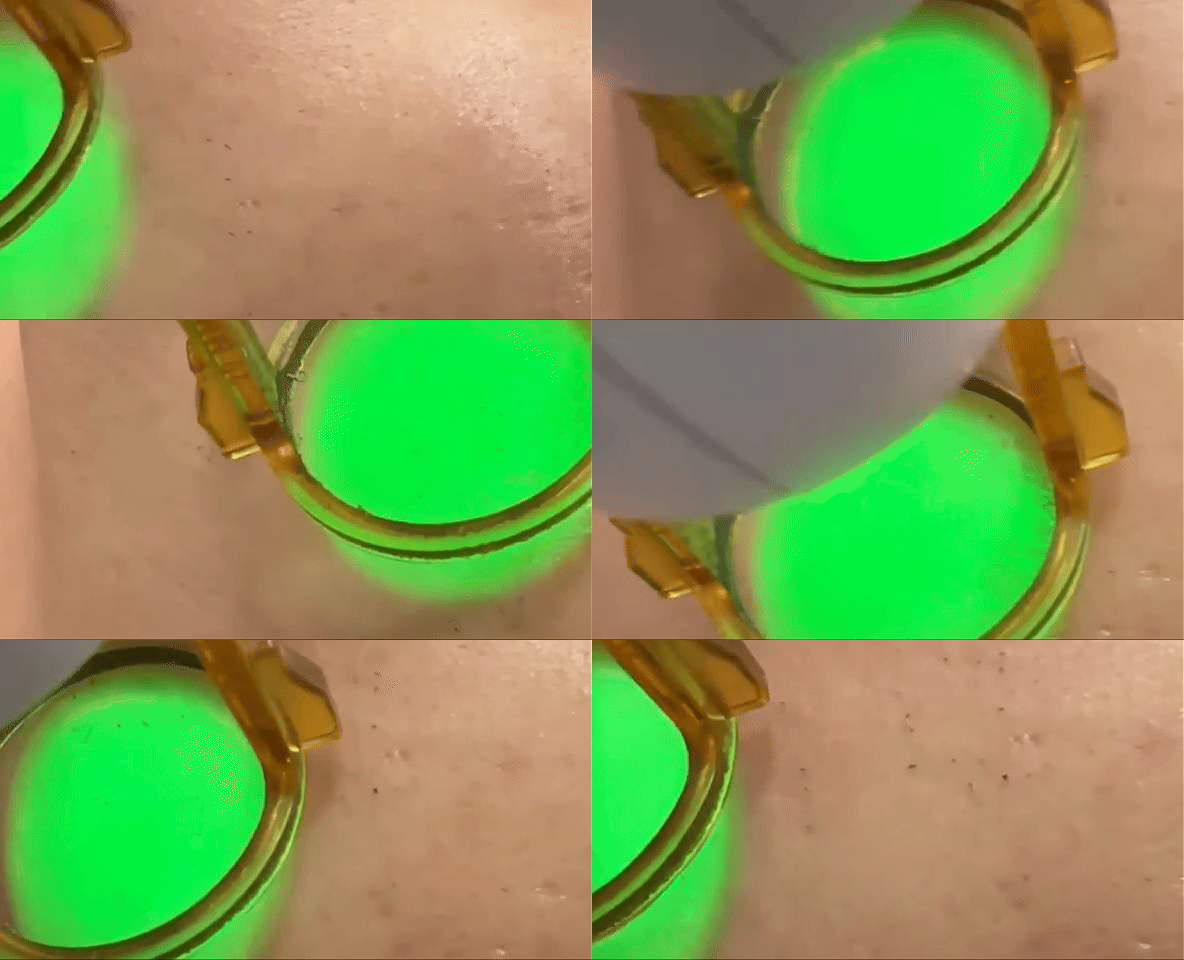 popping-out phenomenon like popcorn
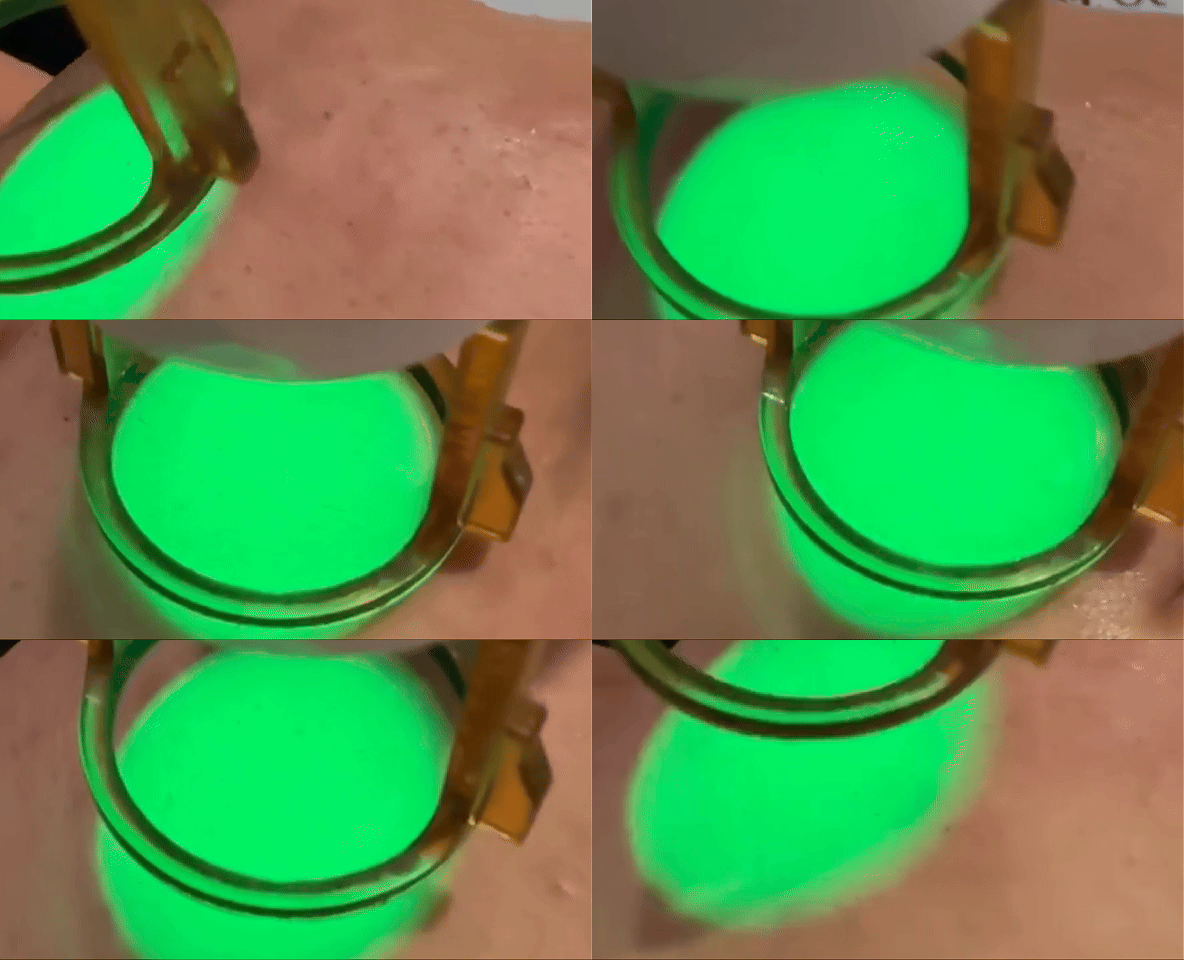 The fur is thin so it's weaker than the one above, but it still pops out.
In other words, the beard showing a little more is
“Physical evidence that actual destruction occurred inside the hair follicle”
In addition, due to the wavelength characteristics of the hair removal laser, it does not react to white beards.
However, the reason you sometimes feel that white hair grows back after hair removal is that the existing black hair disappears,
You can think of it as the original white beard being more visible.
It might hurt, but the only way to get rid of Whitebeard is to pull it out.
So far, through this three-part series, I have shared AZ on the GentleMax Pro Plus hair removal treatment.
If you have any questions, please feel free to leave a comment, and I will personally answer them with the utmost sincerity.
Thank you for reading attentively (_ _)