


What are the most suitable laser hair removal parameters for Koreans?
We studied a lot of data to determine the most suitable hair removal laser parameters.
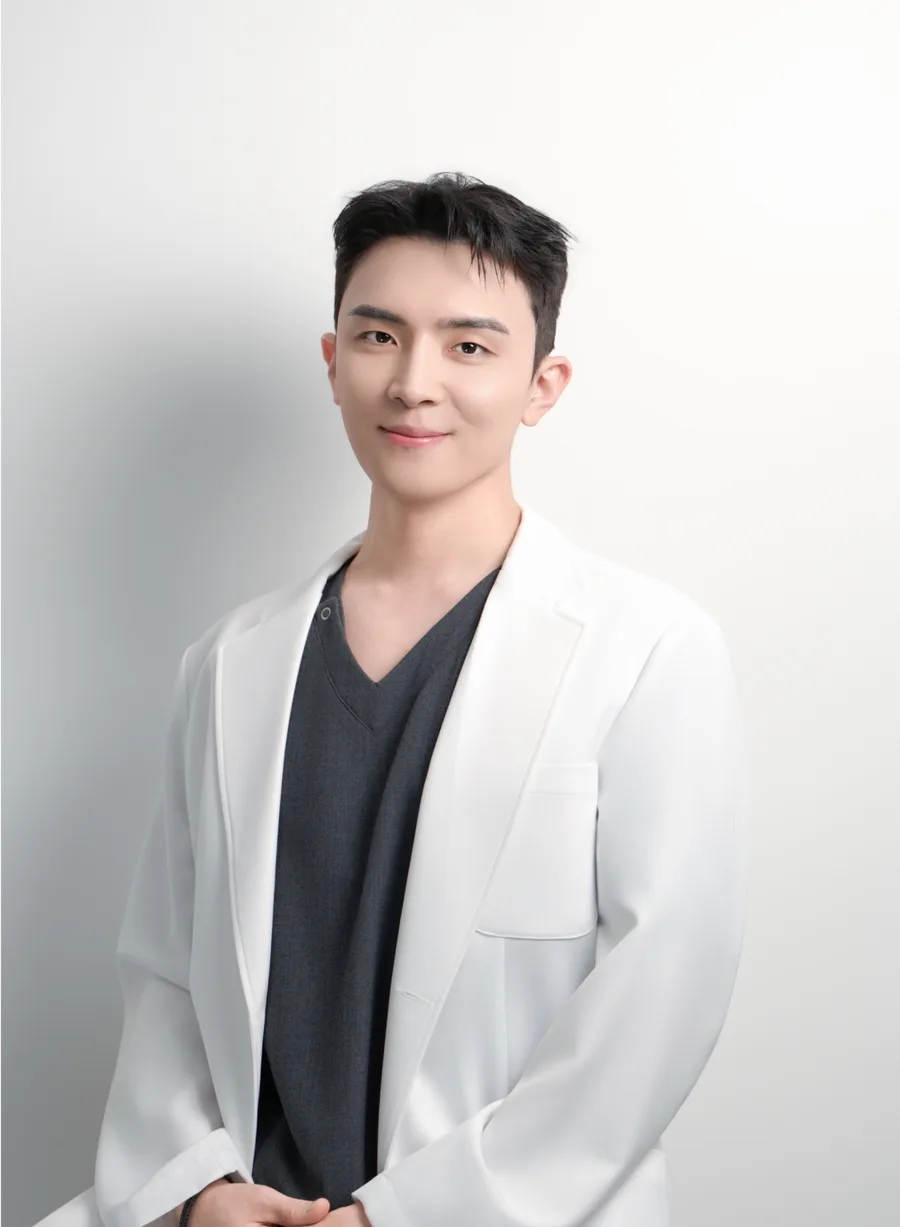
Hello. I am Director Seo Min-ho .
To date, we have entered the results for every person who has received hair removal treatment and checked the satisfaction and inconveniences (side effects) for each session, accumulating over 10,000 pieces of data.
We analyzed this using a statistical program and are sharing the results with everyone!!
(We hope everyone enjoys safe and powerful hair removal results wherever they are.)
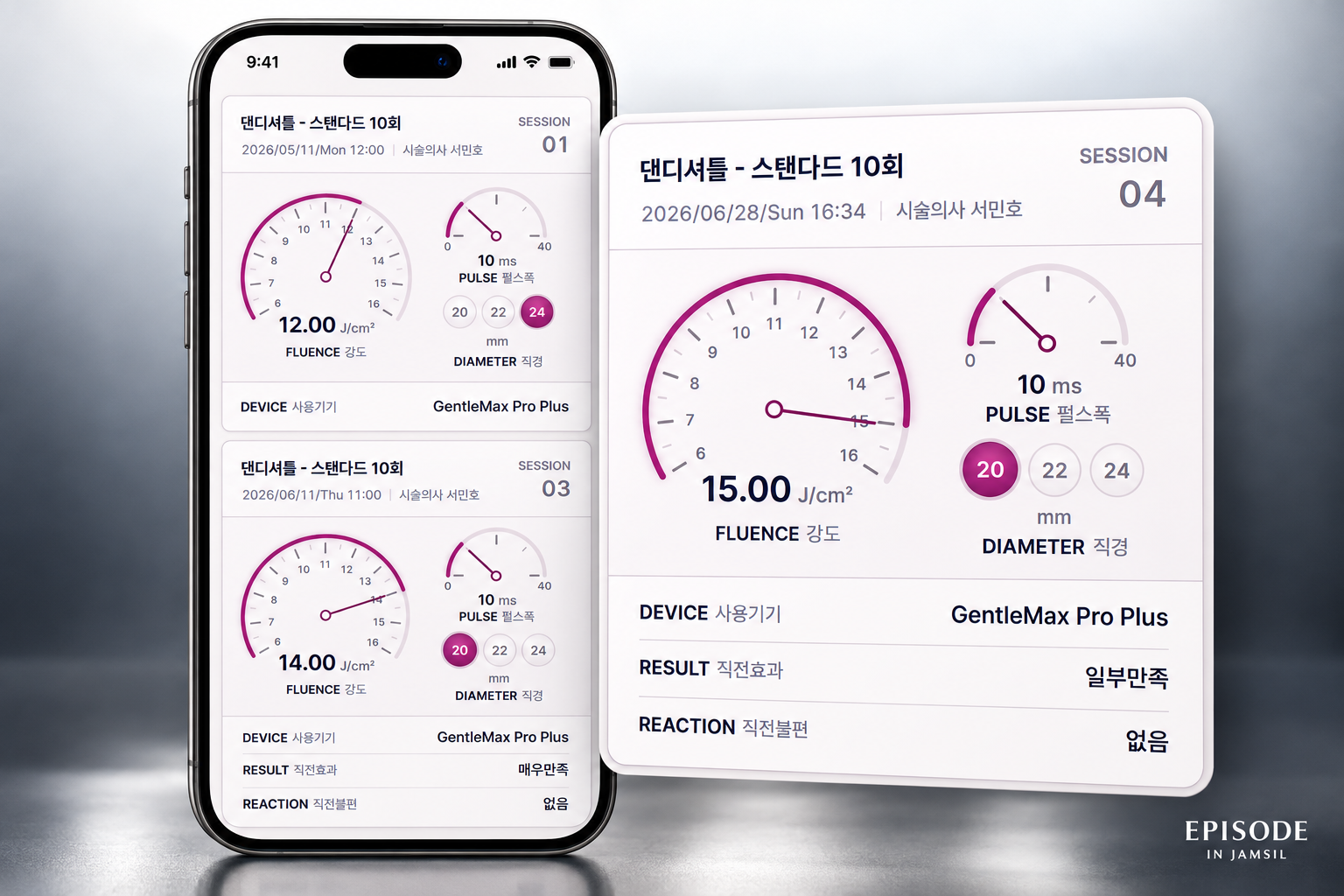 By entering all the data..
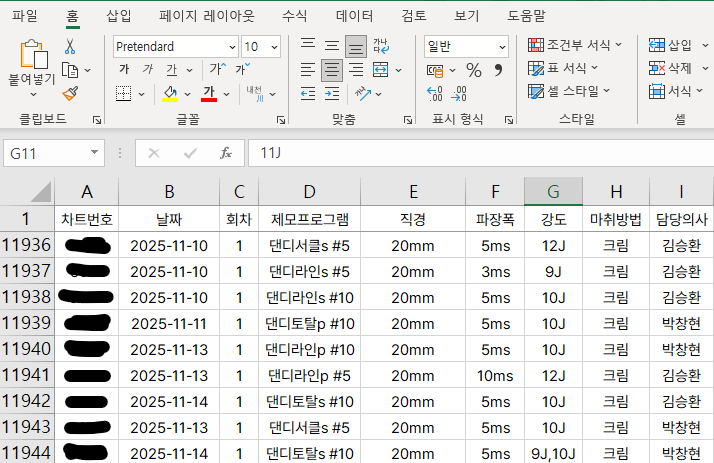 hair removal data that has already well exceeded 10,000 cases
Since a sufficient amount of data has been collected, I intend to perform an analysis.
Initially , it was started to maximize effectiveness and minimize side effects based on the hair removal parameters (intensity, pulse width, diameter, etc.) of the previous session, but
We begin with scientific statistics for everyone's safe hair removal life.
The diameter used was standardized to 20mm. (Refer to Part 1 for the reason.)
1. Satisfaction by Intensity
 Less than 7J is a special case (excluded as it does not require special attention due to the use of cooling and extreme sensitivity to pain).
Analysis method: Scored as Very satisfied (5), Satisfied (4), Average (3), Minimal (2), and None (1) and calculated the average value.
The graph shows a very clear pattern.
▶ 7.5J : Lowest satisfaction (3.0)
→ It is too weak, so the effect is not noticeable.
▶ 8J ~ 9J: Satisfaction rises rapidly
→ The point where the effects start to be felt
▶ 10J ~ 14J: Stably high satisfaction (4.3~4.5) ★
Satisfaction is the 'sweet spot' of hair removal
▶ 15J: Highest Satisfaction (4.77)
As intensity increases, satisfaction rises, but safety and discomfort must also be considered.
Conclusion: As intensity increases, satisfaction increases proportionally.
2. Inconveniences by Intensity
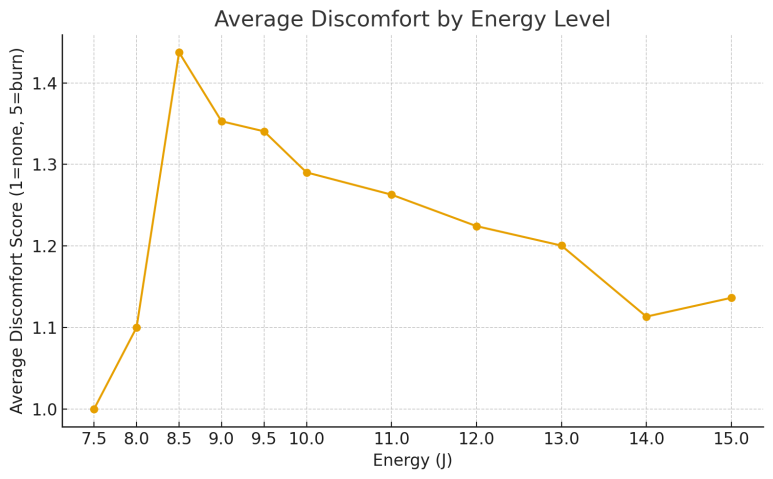
Analysis method: None (1), mild folliculitis (2), severe folliculitis (3), redness for more than 1 week (4), burn (5)
▶ Overall, the level of discomfort is very low
Average 1.0–1.4 range → Mostly no discomfort (a) or mild (b)
→ There are almost no images (d,e).
▶ Highest discomfort level: 8.5J
The discomfort score was highest at 8.5J with an average of 1.44.
→ Mostly b~c (mild to moderate folliculitis)
▶ As the intensity increases, the level of discomfort actually decreases.
10J → 1.29
12J → 1.22
14J → 1.11
▶ Very low discomfort even at 15J (1.14)
15J is the most effective + least uncomfortable
To avoid the error of the mean, we also extracted the actual data as points.
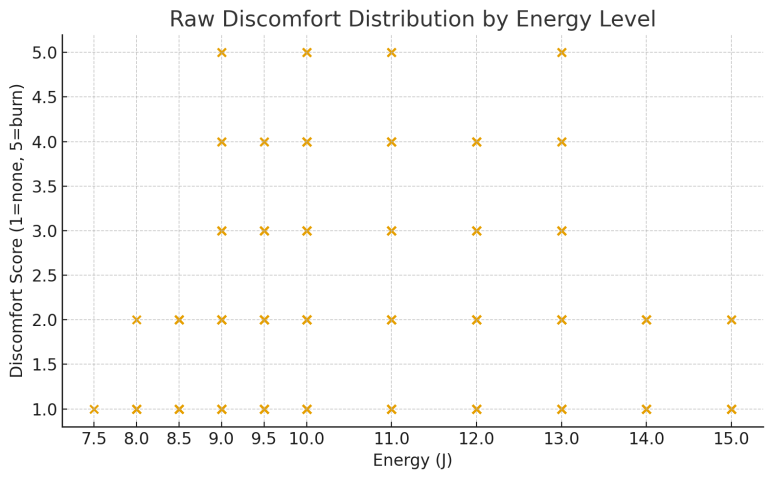
▶ Mostly distributed at 1–2 points ( no discomfort to mild )
hair removal based on the above parameters is basically very safe and low-irritation.
▶ Some 3 to 5 points (severe folliculitis to burns) are present around 8.5J and 9J.
→ Matches the section with the highest discomfort level in the average mentioned earlier.
→ Existence of an ' initial sensitivity zone ' where stimulation actually increases when the initial energy setting is low
▶ At high intensity of 10J or higher, there are almost no high scores (4~5).
→ Safety confirmed that skin reactions do not worsen even at higher intensity
▶ The 12~15J range is almost entirely 1~2 points
On the contrary, the high-intensity section is the most stable and causes the least discomfort.
→ Data showing that the current method's settings are accurate
hair removal the intensity of hair removal does not increase discomfort.
“Discomfort is actually higher at 8–9J, and the high-intensity range (12–15J) is more stable.”
"I know that side effects increase as the intensity goes up, but I wonder why..?"
I will explain the reason for this in the comprehensive summary later!
3. Satisfaction by Session
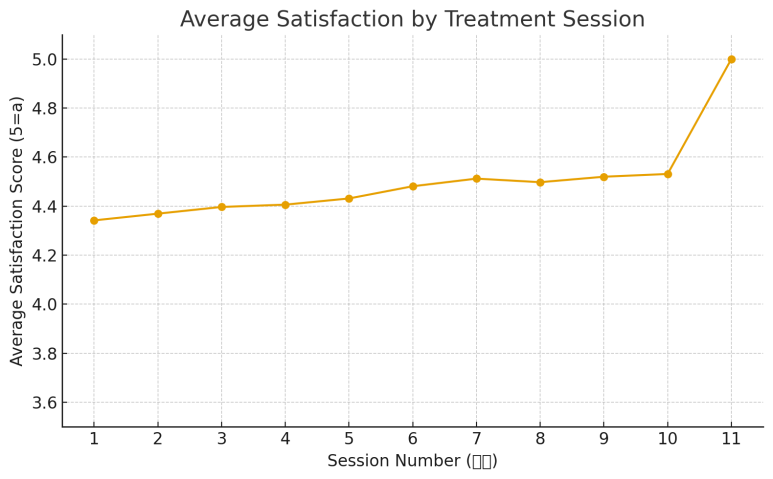 Satisfaction that increases as the episodes progress.
Analysis method: Scored as Very satisfied (5), Satisfied (4), Average (3), Minimal (2), and None (1) and calculated the average value.
▶ Satisfaction steadily increases as the number of episodes accumulates.
Round 1 4.34 → Round 7 4.51 → Round 10 4.53
A subtle but consistently rising upward-sloping graph
▶ ' Most stable and highest satisfaction ' in sessions 6–10
This range is 4.48–4.53, always close to "very satisfied."
Connected to the time when patients feel the greatest effects and changes
▶ Rising again after slight fluctuation in the 8th round
Only the 8th round drops slightly (4.498)
Rebound again in rounds 9-10
▶ Round 11 was 'Completely Very Satisfied (a=5 points)'
Since it is 2025 data, the sample size is small.
However, the patient group continuing up to the 11th session can be interpreted as a group with a very high perceived effectiveness.
"Satisfaction steadily increases with each passing session."
In particular, sessions 6–10 show the highest level of satisfaction and are very stable .
As this hair removal method accumulates It is designed so that you can definitely feel the hair hair removal effect .
4. Inconveniences by Session
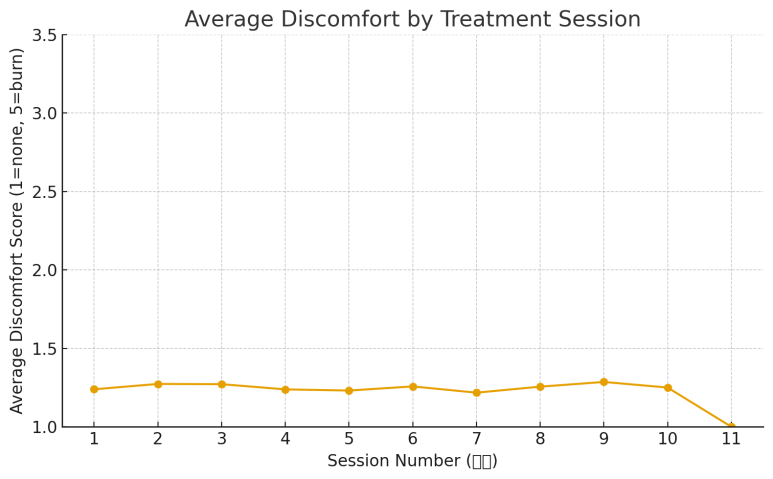 I felt almost no discomfort regardless of the episode.
Analysis method: None (1), mild folliculitis (2), severe folliculitis (3), redness for more than 1 week (4), burn (5)
Hmm... it appears that most people do not experience significant inconvenience without any major differences. However, to avoid the error of averages, I extracted the data as point data.
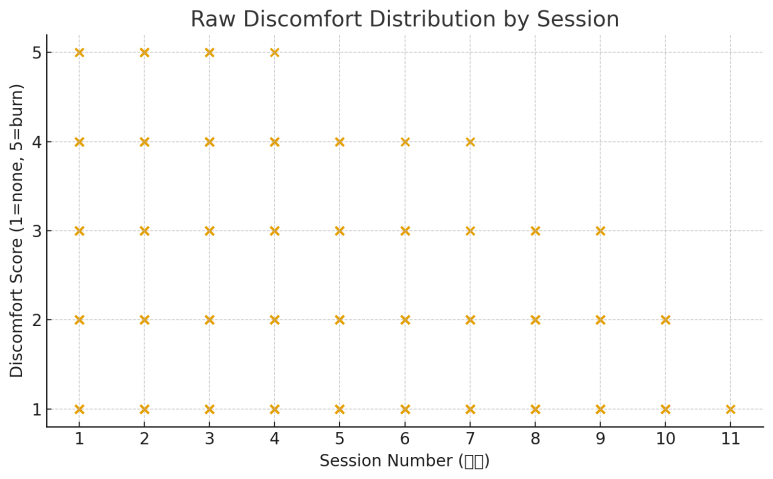 Side effects that caused inconvenience in daily life appeared in a small number of episodes.
"There are cases of side effects where people experience discomfort in their daily lives when the number of sessions is low..!"
and...
"Why do redness and burns lasting more than a week appear more frequently in the “initial session”?"
1) The initial session is the 'pre-skin adaptation' stage.
During the first 1 to 3 sessions, the skin is not yet adapted to the laser.
Even at the same intensity, the skin reaction may be more severe.
In particular, sensitivity to heat around the hair follicle is high in the early stages.
Therefore, most exceptions such as redness lasting more than a week, or burns, occur in the early stages.
2) In the initial session, before intensity and pulse width optimization
Personalized parameters are adjusted as follows.
- Assessment of hair and follicle thickness (Direct visual observation and laser reaction.)
- Assess skin tone and acne propensity (The darker the skin tone, and the more prone the skin is to acne, the higher the risk of side effects.)
- Adjust settings based on pain and response patterns (If you are in extremely severe pain, the intensity cannot be increased...)
- Because the personalized intensity for each patient is not 100% complete in the beginning
There is a high possibility of an unpredictable response (4~5 points).
➡ Settings optimize over time → Stable even at high intensity
3) As subsequent sessions progress, the number of hair follicles decreases → the response itself diminishes
As the number of episodes increases
- The number of targets (hair follicles) struck by the laser gradually decreases → Thermal reactivity also decreases
- Hair follicles thin and the growth stage slows down → The response becomes milder
- Reduced frequency of irritation and folliculitis
➡ As the number of rounds increases, “stability” naturally increases.
4) Perfectly proven in actual data as well
Actual scatter result:
- Discomfort levels of 4 or 5 (redness or burns lasting more than 1 week) mostly appeared only during the 1st to 4th sessions.
- After the 7th round, 4 and 5 points almost disappear, leaving only 1 and 2 points.
- Session 11 has a discomfort score of 1 point, 100%
Even with the same amount of energy, the more sessions there are, the less discomfort there is.
5. Intensity per Session ★ (This is the most important figure.)
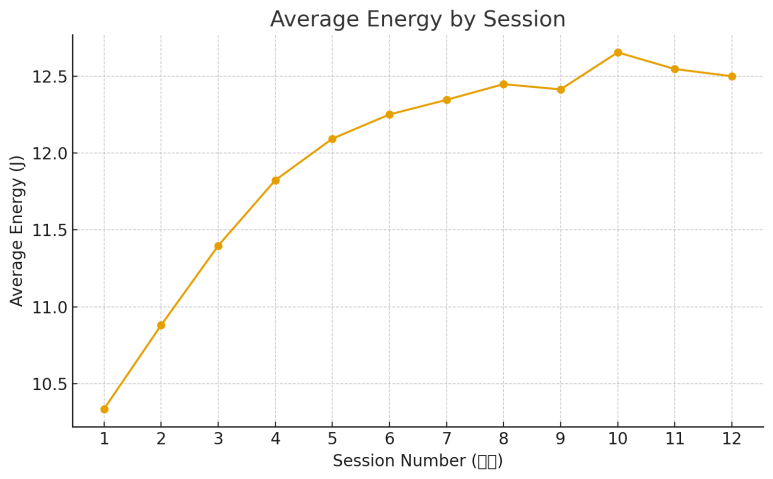
1) As the sessions progress, the intensity naturally increases.
- 1st round: 10.3J
- 5th round: 12.1J
- 10th Session: 12.65J
A pattern that starts low and gradually increases according to skin condition
→ Very normal and safe setting logic.
2) The 7th to 12th interval is stable at 12.3–12.6J.
→ The “range where optimal intensity is reached and maintained” tailored to each individual patient
3) Interesting point: Satisfaction continues to rise, while discomfort remains almost unchanged.
Even though the intensity is increasing
→ The level of discomfort is almost 1.2 (almost none)
→ Satisfaction is steadily rising
➡ Evidence that the step-by-step parameter hair removal setting is the ideal form for maximizing efficiency and minimizing discomfort .
With step-by-step parameter hair removal, even if you increase the intensity
It is a structure that increases only the effect without increasing the inconvenience .
6. Final Conclusion
High levels of discomfort are observed not due to high intensity, but due to the initial session (before adaptation) .
As sessions accumulate, the skin adapts, and as the volume of hair follicles decreases, the skin reaction is not burdensome even at high intensity..
In other words, hair removal treatment must be recorded by session, and
The treatment must be performed with personalized settings.
It is the most effective and safest.
We reached the final conclusion that... (Clap clap clap~~)
The next post is the third and final part of the hair removal laser series. Examples of parameter application during actual hair removal treatment.
I will tell you about the actual results based on the before and after photos.
If you have any questions, please leave a comment and I will answer them in detail.
It wasn't very entertaining since it was just data... but I am confident that the content was substantial!! Thank you for reading this attentively.