



Hello, I am Park Geun-hee, Chief Director of EPISODE CLINIC .
In the previous post, we discussed what melanin is, the reasons why pigmentation occurs in the skin, and various pigmentation disorders, including melasma.
This time, let's look into treatment methods for pigmentation like this.
When you think of pigmentation treatment, the first thing that comes to mind is probably a laser.
When you actually look into laser treatments, there is a really wide variety of equipment available.
In this article, we will examine everything from the basic principles of lasers to the selection of lasers based on the type of lesion.
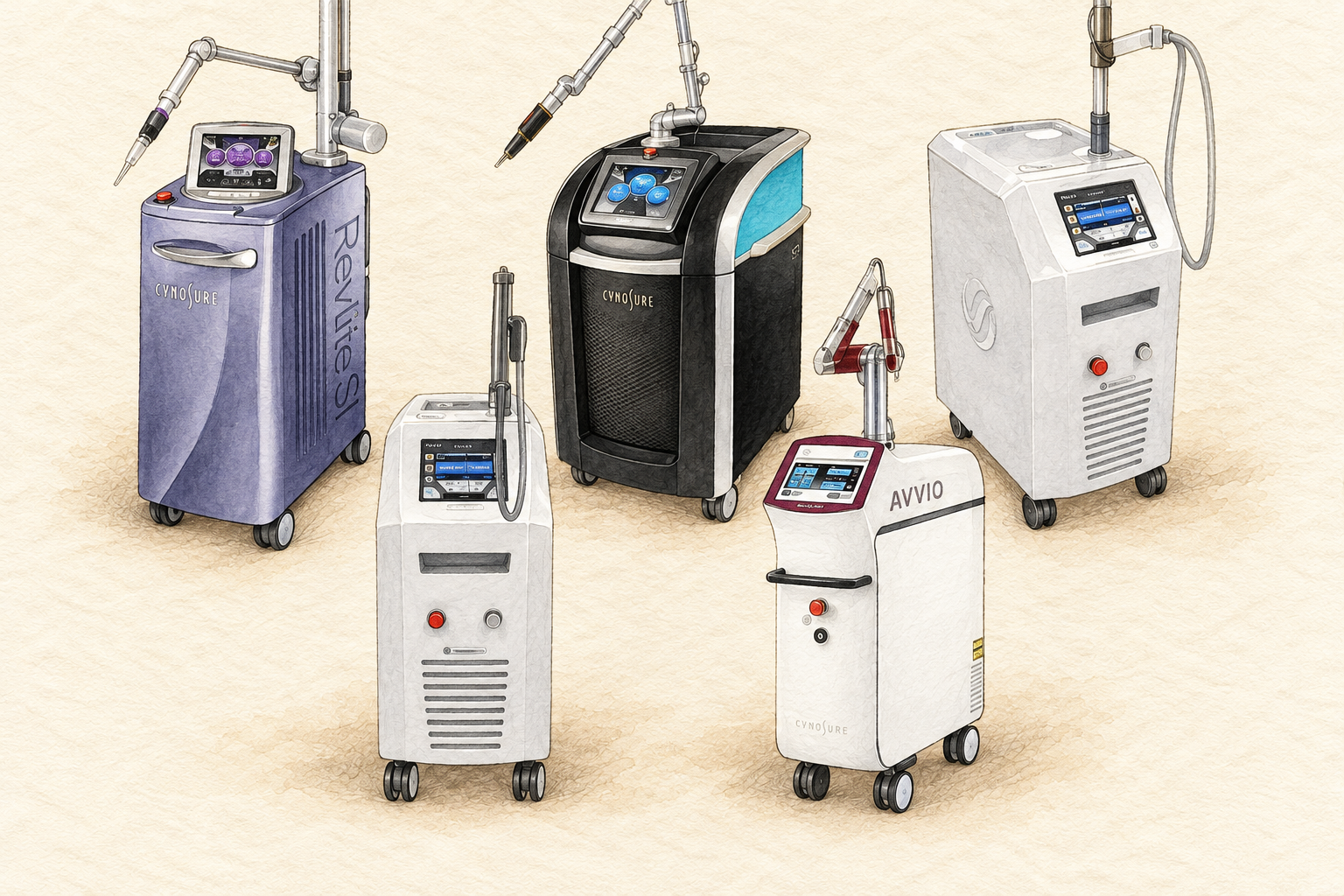 Various lasers used for pigmentation treatment in the EPISODE
1. Basic Concepts for Understanding Laser Treatment
First, here are six terms that appear repeatedly in this text.
1) Wavelength and medium of light
wavelengthWhen light travels in the form of a wave, it is the distance from one point to the next point of the same wave.
Simply put, you can think of it as a path where a light wave repeats once.
It is generally expressed in nanometer (nm) units, and 1 nm is one-billionth of a meter.
Visible light is 380–750 nm. 755 nm Alexandrite and 1064 nm Nd:YAG are outside of that range (infrared).
The wavelength of a laser creates light mediumIt is determined according to.
For example, Nd:YAG uses a wavelength of 1064nm, Alexandrite uses 755nm, and Ruby uses 694nm.
In the case of an Nd:YAG laser, the original 1064nm wavelength can also be converted to 532nm using a KTP crystal.
Generally, short wavelengths like 532 nm are used for superficial pigment treatment, while long wavelengths like 1064 nm are advantageous for reaching relatively deep tissues.
The longer the wavelength, the deeper it penetrates (conceptual diagram)
Since the degree of absorption and penetration depth of lasers in skin tissue vary depending on the wavelength, it is important to select the appropriate laser based on the type and location of the pigment to be treated.
In some cases, a single device can use two or more wavelengths.
For example, GentleMax Pro Plus can utilize 755nm and 1064nm, and Revlite SI can utilize 532nm and 1064nm.
Even when using the same equipment, an appropriate wavelength is selected and applied depending on the type of lesion to be treated.
2) Chromophore
Previously, we examined a method to select a laser wavelength appropriate for the depth of the lesion by targeting melanin pigment.
However, lasers can not only select the wavelength based on the depth of penetration but also vary the wavelength depending on the target being treated.
The important concept at this point is precisely chromophoreno see.
A chromophore refers to a substance that absorbs light of a specific wavelength, and in addition to melanin pigment, hemoglobin and tattoo ink can act as chromophores.
Degrees of absorption by melanin, oxidized hemoglobin, and water by wavelength (conceptual diagram)
Melanin is a chromophore targeted in pigmentation treatment and hair removal.
When melanin in the hair follicles absorbs laser energy, heat is generated, which inhibits hair growth.
Hemoglobin is a substance found in red blood cells and is the primary target of vascular laser therapy.
When hemoglobin absorbs laser energy, heat is generated and affects the blood vessels.
Using this principle, vascular lesions such as flushing, visible blood vessels on the skin, and hemangiomas can be treated.
Lasers are also used for tattoo removal.
Since tattoo ink has different light absorption properties depending on its color, the wavelength is selected to match the ink color.
It irradiates a laser to deliver energy to the ink particles, breaking them into smaller pieces and inducing them to be removed from the body.
Each ink color absorbs different wavelengths well (conceptual diagram)
As such, in laser treatment, the lesion to be treated is diagnosed first, and an appropriate wavelength of laser is selected by considering which chromophore to target and how deep it needs to penetrate.
3) Pulse width
Even with lasers of the same wavelength, the energy delivered to the skin and the reaction can vary depending on how short or long the light is irradiated.
Long-pulse laserIt is a method of transferring heat by irradiating light for a relatively long period of time.
Heat raises the temperature of the target tissue to induce a therapeutic response, which is called the photothermal effect.
This is used not only for pigmentation treatment but also for the treatment of vascular lesions and hair removal.
Q-switched laserIt is a technology that concentrates high energy in a short period of time.
Mainly in nanosecond units pulse widthIt uses [the device] to not only transfer heat to the pigment particles but also finely grind the pigment through a photoacoustic effect.
Picosecond laserIt irradiates the laser in picosecond units, which are 1,000 times shorter than nanoseconds.
It reduces heat diffusion with a short pulse width and finely breaks down pigments through strong photoacoustic and photomechanical action.
To use an analogy, a Q-switched laser breaks pigment particles into relatively large pieces like pebbles, while a pico laser breaks them down into much finer pieces like sand.
(There is a more detailed explanation of laser principles, such as the photothermal, photoacoustic, and photomechanical effects, below!)
4) Energy density and spot size
energy densityJ is the amount of energy delivered by a laser to a specific area, generally expressed in units of J/cm².
Simply put, it is a value indicating how much laser energy is delivered to a specific area of the skin.
While higher energy density delivers more energy to the target tissue and can lead to a stronger response, simply having a higher density does not guarantee better therapeutic efficacy.
Excessively high energy can damage surrounding tissues or cause side effects, so it must be adjusted appropriately according to the type and depth of pigmentation and skin condition.
Spot sizerefers to the size of the area where the laser is irradiated onto the skin.
Generally, as the spot size increases, the proportion of energy lost due to light scattering at the skin surface decreases, which can be advantageous for laser energy to reach relatively deep tissues.
Conversely, a small spot size is advantageous for irradiating a narrow area with a laser, making it suitable for treating small lesions or specific sites.
Energy density and spot size influence each other, so they must be considered together.
Even if the same amount of energy is used, the amount of energy delivered per unit area can vary depending on the irradiation area.
Laser therapy is a process of inducing a desired response by selecting appropriate pulse width, energy density, and spot size.
Even for the same pigmented lesion, treatment settings may vary from patient to patient, and even for the same patient, parameters are adjusted according to skin condition or treatment progress.
2. Principles of Laser Therapy
So far, we have examined the basic concepts of laser treatment.
Then, what kind of reaction occurs after the laser light is absorbed by the skin?
Lasers can cause reactions in tissues as light energy is converted into thermal energy, or they can induce mechanical effects such as pressure waves by delivering energy in a short period of time.
This time, focusing on these differences, we will explore the principles of laser therapy, such as selective photothermal decomposition, photoacoustic, and photomechanical effects.
1) Selective Photothermal Decomposition
When laser light is absorbed by skin tissue, light energy is converted into heat energy, causing the tissue temperature to rise.
This photothermal effectIt is said that.
Various lasers used in Dermatology utilize this principle to deliver thermal energy to specific targets, such as melanin pigments or blood vessels.
However, even if the laser is absorbed by the target pigment and generates heat, the generated heat can spread to surrounding tissues.
It is important to induce a sufficient response in the target tissue while minimizing damage to surrounding normal tissue.
These principles Selective photothermolysisIt is said that.
Several conditions are required for selective photothermal decomposition to occur.
First, you must select a wavelength that the target to be treated absorbs well.
Here, the pulse width and energy must be adjusted to deliver sufficient energy to the target tissue while minimizing heat diffusion to surrounding tissues.
(The things explained in the basic concepts section were necessary to understand selective photothermal decomposition.)
In pigmentation treatment, melanin is the primary target.
The appropriate wavelength and irradiation conditions vary depending on whether the pigment is in the epidermis or dermis, and the size and characteristics of the pigment.
For example, Q-switched Nd:YAG lasers are used to treat pigmented lesions and can utilize the principle of selective photothermal decomposition depending on the equipment and settings.
However, not all dye lasers function in the same way, and there are devices, such as pico lasers, where photoacoustic and photomechanical effects play a significant role.
2) Heat Relaxation Time (TRT)
Terms worth examining when understanding selective photothermal decomposition TRT (Thermal Relaxation Time)no see.
TRT refers to the time it takes for heat to spread to the surroundings and cool down from a target tissue heated by absorbing laser energy.
TRT varies depending on the size and characteristics of the target.
Generally, the smaller the target, such as small pigment particles, the shorter the TRT tends to be, while the larger the tissue, the longer the TRT tends to be.
Therefore, it is important to select an appropriate pulse width depending on the target of treatment.
In selective photothermal decomposition, the pulse width must generally be equal to or shorter than the target's TRT (PD ≤ TRT) applies the principle.
This is to deliver laser energy within a short period of time to sufficiently raise the target's temperature and induce the desired reaction in the target before the heat spreads widely to surrounding tissues.
Conversely, if the pulse width is excessively longer than the target's TRT, the heat has more time to spread to surrounding tissues, which can lead to greater thermal damage to those tissues.
3) Extension theory of selective photothermal decomposition
In pigment treatment, it is important to minimize damage to normal tissues by preventing the heat generated at the target from spreading excessively to surrounding tissues.
however Extension theory of selective photothermal decompositionIn this case, the characteristic of heat being transferred to the surroundings is actually utilized for treatment.
Representative examples are hair removal and vascular laser treatment.
The light-absorbing chromophore does not coincide with the tissue actually intended for treatment, and heat generated from the chromophore is transferred to the surrounding treatment target to induce the desired response.
Hair removal lasers deliver energy to the melanin present in the hair and hair follicles.
When melanin absorbs light and generates heat, this heat is transferred to the surroundings and affects the tissues involved in hair production in the hair follicles.
In other words, there may be a distance between melanin, the light-absorbing chromophore, and the tissue actually intended to be damaged.
Vascular lasers are similar.
In this case, the chromophore that absorbs light is hemoglobin in the blood, and when hemoglobin absorbs laser energy, heat is generated.
This heat is transferred to the blood vessel walls, producing a therapeutic effect by inducing damage to the blood vessels or coagulating them.
As such, in hair removal and vascular treatment, the process in which energy absorbed by chromophores is converted into heat and then delivered to surrounding treatment targets is important.
The treatment response may vary depending on the distance between the chromophore and the target tissue, the time of heat transfer, and the characteristics of the surrounding tissue.
4) Photoacoustic and optomechanical effects
While the previously explained selective photothermal decomposition primarily utilizes heat to induce a reaction in target tissue, other reactions can also occur when laser energy is delivered over a very short period.
A representative example is photoacoustic effectand photomechanical effectno see.
The photoacoustic effect is a phenomenon in which a dye absorbs laser light, heats up very rapidly, and expands to generate pressure waves.
This pressure wave can contribute to breaking down the pigment into smaller pieces by transmitting mechanical force to the pigment particles.
Unlike methods that damage targets using heat, it is characterized by the fact that rapid pressure changes and mechanical reactions play a crucial role.
The optomechanical effect is a concept that encompasses mechanical actions, such as expansion, pressure, and shock waves, that occur as laser energy is rapidly delivered to a target.
It is closely related to photoacoustic effects, and the two terms do not refer to completely separate phenomena.
If the photoacoustic effect is a term that focuses on pressure waves generated by the absorption of light, the optomechanical effect can be understood as a term that emphasizes the mechanical action caused by that pressure and impact on a target.
These effects are utilized in pigment treatment or tattoo removal.
For example, picosecond lasers have a very short pulse width to rapidly deliver energy to pigments and are used to break down pigment particles through photoacoustic and photomechanical reactions.
5) Stress Relaxation Time SRT
When understanding photoacoustic and optomechanical effects SRT (Stress Relaxation Time)The term appears.
If TRT is a concept related to the time it takes for heat to diffuse into the surroundings, SRT is related to the time it takes for the pressure and mechanical stress generated by laser irradiation to be transmitted and relieved within the target.
When laser energy is absorbed by the pigment for a very short period of time, the pigment heats up rapidly and expands.
The pressure generated at this time can be transmitted to the surroundings, creating pressure waves.
If the energy transfer time is shorter than the SRT, pressure can be rapidly formed inside the target before spreading to the surroundings, which is advantageous for inducing a photoacoustic response.
This stress confinementIt is called.
3. Summary
Although I wrote it at length, I end up summarizing it as follows when explaining it to patients.
Lasers work by utilizing the heat generated as pigments absorb light irradiated onto the skin, or by breaking down pigment particles into smaller pieces using instantaneous pressure.
For each patient, the type and depth of pigmentation and skin condition are examined to select the appropriate laser equipment, and parameters such as energy density and irradiation area are determined.
Afterwards, adjustments are made while monitoring the actual skin reaction and treatment progress.
4. Conclusion
I tried to explain laser treatment as simply as possible. Did you understand it well?
There may be parts that are difficult to understand at once due to the many unfamiliar terms, but I hope this article has been of at least some help in understanding laser treatment.
In the next post, I will discuss the therapeutic window, an important criterion for determining treatment efficacy and safety, and the methods used for pigment treatment other than lasers.
We also plan to address questions you may have wondered about at some point while receiving pigmentation treatment, so please look forward to the next post.
Thank you for reading!