



Hello, I am Park Geun-hee, Director of EPISODE CLINIC .
In the previous post, we looked at the principle of how lasers use light to act on pigments and how to select a laser based on the lesion.
In this article, important in actual treatment therapeutic windowand clinical end-pointI will examine this and discuss the reasons why pigmentation needs to be consistently managed even after laser treatment, as well as various methods that can be utilized in addition to lasers.
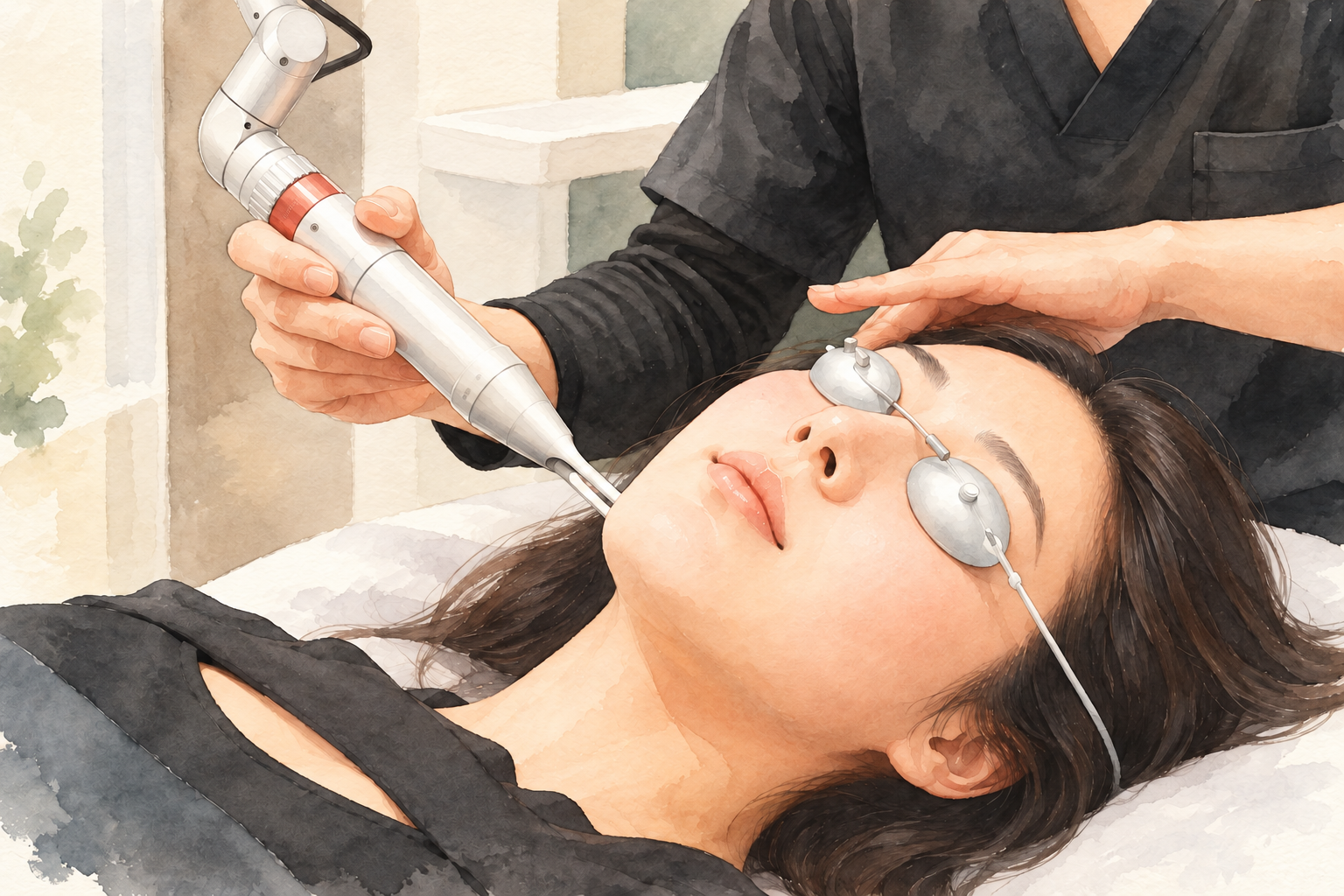 Laser treatment that gradually builds up effects with consistent treatment
When consulting about laser toning, I frequently receive the question, “How many sessions is usually required?”
Generally, at 2-week intervals 10th time You will be guided to undergo the treatment as a treatment plan.
You might think it is a marketing ploy if I say you need to receive 10 treatments from the start, but the number of treatments required and the expected effects vary depending on the type of pigment.
Freckles or some lentigines can be noticeably improved with just a single treatment, depending on the characteristics and depth of the lesions.
On the other hand, melasma may be difficult to completely disappear even with multiple treatments, and the goal is to gradually lighten the color.
Therefore, it is important to establish a treatment plan tailored to the type of pigmentation and skin condition.
As changes appear gradually, some patients feel frustrated during treatment and say, "Please make it a little stronger," or "Please treat it until a scab forms."
Depending on the situation, treatment using high energy may be suitable, but the same method cannot be applied to all pigments.
Strong stimulation can actually worsen pigmentation.
Let's examine the reason starting with the concept of the scope of treatment.
1. Efficacy and Safety of Laser Treatment
1) Therapeutic window
In laser therapy, increasing the energy does not mean that the treatment effect will continue to improve.
If the energy is too low, it may not trigger a sufficient reaction in the pigment, resulting in minimal improvement.
Also, if the energy is excessively high, unnecessary stimulation can be applied not only to the pigment but also to surrounding normal tissues.
Therapeutic window: A balance between sufficient efficacy and skin safety
The range within which therapeutic effects can be expected while keeping the risk of skin damage as low as possible is called the therapeutic window.
In laser treatment, it is important to find a balance between sufficient efficacy and skin safety.
Laser toning, in particular, has a relatively narrow treatment range.
Excessively strong stimulation can cause an inflammatory response.
When inflammation occurs, the activity of melanocytes increases, causing the treatment area to actually become darker. Post-inflammatory hyperpigmentation (PIH)This may appear.
In addition, excessive irritation may cause redness and swelling to persist for a long time, or lead to unintended skin damage or scarring.
Conversely, when the function of melanocytes is impaired or damaged, the treatment area appears whiter than the surrounding area HypopigmentationThis may appear.
especially melasma is a pigmentation disorder sensitive to irritation and inflammation.no see.
If you undergo strong treatment with the aim of rapidly reducing pigmentation but the color actually darkens, it may become more difficult to improve than before.
Therefore, in melasma treatment, it is important to take a gradual approach while monitoring the skin's response within its tolerable range, rather than removing a large amount of pigment at once.
2) Clinical endpoint
If the treatment range refers to the range of energy that can be safely used for treatment, the clinical endpoint is a criterion for determining how far to treat and stop irradiation based on skin reactions that occur during or immediately after the treatment .
The appropriate treatment endpoint depends on the type of laser, the purpose of treatment, and the characteristics of the lesion.
In pigmented lesions, perilesional erythema may appear around the lesion, or immediate whitening may be observed, where the lesion temporarily turns white.
In vascular lesions, reactions such as the disappearance or noticeable fading of blood vessels, or grayish discoloration, can be used as treatment endpoints.
In hair removal , perifollicular erythema and edema, where the area around the hair follicle becomes red and swollen, and a pop-out phenomenon, where the hair appears to be pushed out of the follicle, may be observed.
However, in laser toning, it is not always appropriate to irradiate strongly until noticeable changes appear.
This is because it is important to induce the necessary reaction in the pigment without causing excessive heat and inflammation to the skin.
Slight redness of the skin may be observed immediately after the treatment , but you should not assume that the stronger the redness, the better the effect.
You must check not only the reaction immediately after the treatment but also how the skin recovers over the next few days, and whether the pigmentation fades or actually darkens afterward.
Therefore, rather than fixing the treatment energy and interval from the beginning, it is necessary to adjust them according to the skin response and the progress of treatment.
This is because even the same person's reaction can vary depending on skin condition, the season, and the degree of UV exposure.
3) Number of treatment and treatment cycle
It is difficult to accurately predict the number of laser toning treatments required from the start, as it depends on the type and depth of pigmentation, skin condition, and response to the laser.
It is helpful to understand the commonly recommended 10 treatment sessions as the number of sessions frequently performed in clinical studies related to laser toning .
In fact, several studies on patients with melasma evaluated the degree of pigmentation improvement after approximately 8 to 10 treatment sessions, and in a systematic review synthesizing related research papers, studies on laser toning alone generally involved about 9 to 10 sessions.
However, this does not mean the standard number of treatments required for all patients or the number of treatments that must be completed.
The treatment cycle is generally 1~2 weeks We will proceed to that extent.
The number of treatment and the frequency can be adjusted according to skin response and progress.
As previously discussed, since laser toning has a narrow treatment range, it is important to set appropriate conditions tailored to the skin condition.
Rather than treating strongly all at once, it is important to make gradual improvements while adjusting parameters to avoid putting strain on the skin.
This is because if you increase the energy excessively with the intention of immediately reducing pigmentation, it can actually damage the skin, causing the pigmentation to become darker or the skin to become patchy and unevenly white.
2. Why UV Protection Is Important
Even if the laser effectively breaks down existing pigments during treatment, continued exposure to ultraviolet rays can stimulate melanin synthesis, potentially reducing the effectiveness of pigment improvement compared to expectations.
Treatment to reduce pigmentation and management to prevent the formation of new pigmentation must be carried out together.
Even if the pigmentation has sufficiently faded and satisfactory results have been obtained after the treatment UV protectionIt is important to take consistent care of it.
This is because just because pigmentation has improved through treatment does not mean that the skin's function of producing melanin or the environment prone to melasma has completely disappeared.
It is easy to understand if you compare it to exercise and dieting.
Just because you have lost weight through diet control and exercise does not mean that you will maintain that state forever even if you completely abandon your lifestyle habits afterward.
Similarly, even if you have improved pigmentation through toning, the pigmentation may darken again if skin aging progresses without reducing UV exposure.
Therefore, it is recommended to consistently use sunscreen even after toning, and to reapply it when staying outdoors for a long time.
Reducing the time spent in direct exposure to sunlight by using a hat or parasol is also helpful.
Even after treatment is finished, regular care is important.
3. Pigmentation improvement methods other than lasers
melasma is a condition involving not only melanin production but also various factors such as inflammatory responses, vascular changes, skin barrier and dermal conditions.
Therefore, in addition to pigment laser treatment, drug treatment and high frequencyYou can also consider a Skin Booster treatment.
However, please note that the methods introduced below are options that can be used as supplementary treatments for pigmentation.
1) Tranexamic acid
Tranexamic acidIt is a drug originally used to reduce bleeding, but it is also used to treat melasma .
In the skin, inhibiting the plasmin pathway reduces the signals that promote melanin production.
It is known to affect signal transmission between keratinocytes and melanocytes, and to be involved in vascular changes associated with melasma.
Oral tranexamic acid is well known as the product Doransamin.
In studies on melasma treatment, the method of taking 250mg twice a day was frequently used.
In one study, the degree of pigmentation improvement was evaluated after administering 250 mg twice a day for 6 months to 75 patients with melasma .
In the study, many patients showed improvement from the beginning of treatment, and overall improvement in pigmentation was observed even after 6 months.
Caution should be exercised with Doransamin if there is a history of thrombosis or a risk of blood clot formation, and the use of combined hormonal contraceptives and kidney function should also be checked.
Therefore, rather than taking it arbitrarily, you should evaluate your health condition and risk factors before deciding whether to take it and for how long.
2) High-frequency treatment
High frequency is a treatment that utilizes the heat generated as an electric current passes through tissue.
Although there are differences depending on the equipment and treatment method, it is used to deliver thermal stimulation to the dermis to induce collagen production and improve skin elasticity.
Recently, research has been conducted focusing on the fact that age-related facial pigmentation is influenced not only by increased melanin production but also by dermal aging and damage to the dermal-epidermal junction. In particular, unipolar radiofrequency delivers heat to the dermis to improve the skin environment and can influence melanin production, which may help alleviate pigmentation caused by aging.
While high-frequency therapy does not directly remove pigmentation, it is a method that can be considered as an auxiliary option when taking into account skin elasticity and the dermal environment.
3) Topical preparations used for pigmentation improvement
In addition to lasers, topical agents that inhibit melanin production or aid in the replacement of dead skin cells can be used for pigmentation treatment.
Representative examples include hydroquinone, retinoids, azelaic acid, and vitamin C.
Since each ingredient has a different mechanism of action, effect, and level of irritation, it is important to choose one that suits your skin condition.
HydroquinoneIt is a medication that helps improve skin hyperpigmentation such as melasma and freckles.
It inhibits the action of tyrosinase, which is involved in the melanin synthesis process, thereby reducing the production of pigment.
However, if hydroquinone is applied at high concentrations for a long period, the skin actually becomes darker. exogenous ochronosisThis may occur, so caution is required when using it.
You must discontinue use if skin irritation worsens or the color changes abnormally.
Retinoidis a general term for vitamin A derivatives, Retinol(Retinol) and TretinoinThis is included here.
The two ingredients differ in the way they act on the skin and their strength.
Retinol is an ingredient primarily used in cosmetics, and after being absorbed into the skin, it is converted into tretinoin via retinal to exert its effects.
Because a conversion process is required, it generally has a weaker effect than tretinoin and causes less skin irritation.
It is used to improve skin texture, fine lines, and dull skin tone by promoting skin turnover and collagen production.
TretinoinIt is an active form of retinoid that acts directly on the skin and is a medicine primarily used for treating acne.
It promotes the differentiation and replacement of keratinocytes to reduce clogged pores, and helps keratinocytes containing melanin to be expelled to the skin surface, making it useful for improving pigmentation.
In addition, it can help improve fine wrinkles caused by photoaging by inhibiting collagen breakdown and promoting production.
You must strictly protect yourself from ultraviolet rays when using hydroquinone and retinoids.
In particular, retinoids can cause skin irritation and increase sensitivity to sunlight.
photosensitivityThis refers to a phenomenon where the skin's reaction to light becomes stronger than usual due to the influence of certain substances.
The skin may become dry, red, or peel, and if irritation becomes severe, post-inflammatory hyperpigmentation may actually worsen.
Since hydroquinone can also cause pigmentation to darken or skin color to change upon exposure to sunlight, it is important to apply sunscreen thoroughly and reduce sun exposure while using both ingredients.
also During pregnancyIf you are pregnant or planning to get pregnant, you should be careful with the use of both ingredients.
Topical retinoids should be avoided during pregnancy, and it is recommended not to use them even if you are planning a pregnancy.
Hydroquinone has a relatively high absorption rate through the skin, and since there is insufficient data regarding its safety during pregnancy, it is recommended to avoid using it during pregnancy.
Ultimately, these topical agents are for pigment treatment. auxiliary methodno see.
It is important to consider pigmentation-reducing treatments, UV protection, and lifestyle habits that minimize skin irritation together.
4. Frequently Asked Questions (FAQ)
“I have blemishes on my face. What kind of treatment should I get?”
The appropriate treatment for pigmented lesions varies depending on their type and depth.
Pigments located in the epidermis, such as freckles or some lentigines, can be treated using wavelengths that are well absorbed by the pigment.
On the other hand, for lesions where melanocytes are distributed deep within the dermis, such as nevus of Ota, a laser capable of acting deeper is considered.
First, it is important to accurately identify the type of pigmentation and establish a treatment plan tailored to the characteristics of the lesion and the skin condition.
Q. Can it be treated with a laser that forms scabs?
A. A scab may form after freckle treatment using a 532nm wavelength laser or lentigo treatment using Repot.
There is also a method to remove pigmented lesions using an erbium YAG laser.
You can see the pigment fading as the scab naturally falls off over time.
However, just because a treatment causes scabs to form does not necessarily mean it is better.
In particular, since the erbium YAG laser directly ablates skin tissue, post-inflammatory hyperpigmentation (PIH) may occur after the treatment , potentially causing the pigmentation to become darker.
Creating a scab to remove the pigment is not the goal of the treatment itself.
It is important to accurately diagnose the characteristics of the lesion and select the most suitable treatment method while minimizing unnecessary skin damage.
Q. Do I have to receive treatment 10 times for the first time? Can't I just do it once?
A. The appropriate number of treatment may vary depending on the type of pigment.
Noticeable improvement can be expected for freckles or some blemishes with just a single treatment.
On the other hand, melasma is difficult to completely remove with a single treatment.
Since studies often evaluate the effectiveness of laser toning after around 10 treatments, we commonly recommend about 10 sessions as a standard.
However, if the treatment response is sufficient, the frequency can be reduced, and if improvement falls short of expectations or skin irritation persists, the treatment plan must be readjusted.
Q. Does receiving a stronger laser treatment show results faster?
A. That is not always the case.
If the energy is too low, it may not act sufficiently on the pigment, but if it is excessively high, the risk of inflammation and skin damage may increase.
In particular, excessive melasma can actually cause the pigmentation of melasma to darken.
In laser treatment, not only energy but also wavelength, pulse width, spot size, lesion depth, and skin condition must be considered together.
Rather than judging the effectiveness based solely on energy intensity, it is advisable to examine the skin's recovery process and changes in pigmentation together.
Q. Can I receive other treatment while getting toning ?
A. Laser toning, lifting, and treatment can be combined.
In addition to toning for pigmentation improvement , treatment treatment as radiofrequency lifting and Skin Booster to improve skin elasticity and the dermal environment helps to manage skin concerns more comprehensively.
However, since the mechanism of action and recovery period differ for each treatment, the appropriate combination and order of treatment may vary depending on the skin condition.
It is recommended to consult thoroughly with medical staff to decide which treatment to receive together.
Q. Does receiving toning treatments repeatedly over a long period of time cause the skin to become thinner?
A. Because the ablative lasers used in the past treated by abrading tissue on the surface of the skin, repeated procedures can damage the skin barrier and cause scarring during the recovery process, placing a burden on the skin.
On the other hand, lasers recently used for pigmentation treatment, such as Revlite or PicoSure, primarily utilize the principle of delivering energy to melanin to break down pigment particles into smaller pieces.
It works differently from ablative lasers that remove the surface of the skin, and when irradiated with appropriate energy, it can treat pigmentation deep within the skin while minimizing damage to the epidermis.
Therefore, repeating laser toning does not necessarily mean that the skin will become thinner.
However, if the energy is excessively high or if the treatment repeatedly beyond the skin's tolerance, the skin may be damaged.
Therefore, parameters tailored to the individual's skin condition are selected and adjusted while monitoring the skin's response during the treatment process.
Q. I have received 10 toning sessions and am satisfied with the improvement. Should I continue receiving treatments?
A. If the pigmentation has improved sufficiently, there is no need to continue receiving toning treatments unconditionally.
Whether to continue treatment is determined based on the current skin condition, the degree of pigmentation, and the response to previous treatments.
If your skin remains stable, focus on sun protection and consistent skin care; if pigmentation darkens again or changes occur, check your condition and consider additional treatment.
Q. Will melasma get darker again if I stop toning ?
A. toning toning does not necessarily mean that melasma will recur.
However, since toning is not a treatment that completely eliminates the skin environment itself, which is prone to melasma, the pigmentation may darken again over time.
Just as weight can fluctuate depending on lifestyle habits even after losing weight through exercise and diet, melasma is also affected by post-treatment care and the external environment.
Continuously receiving toning treatments is not the only answer; it is important to consistently protect yourself from UV rays and take care of your skin on a daily basis.
Q. Can melasma completely disappear if I get toning ?
A. It is difficult to completely eliminate melasma with a single treatment, and there is a possibility of recurrence even after multiple treatments.
Through treatment, the color may lighten and become less noticeable, but it is difficult to guarantee that all pigment will completely disappear.
Therefore, rather than aiming for complete removal from the start, it is advisable to aim to improve pigmentation within a range that does not strain the skin, and to reduce recurrence through UV protection and consistent care.
5. Conclusion
In this article, we explored the effectiveness and safety of laser treatment, the importance of UV protection, and pigmentation improvement methods available other than lasers.
Pigmentation treatment is not simply about irradiating with a laser.
It is necessary to accurately identify the type of pigmentation, treat it within the skin's tolerance, and manage it after treatment to prevent it from darkening again.
It is necessary to select appropriate laser equipment and parameters tailored to the skin condition and pigmentation characteristics; furthermore, the practitioner's proficiency and meticulous monitoring of the progress are also important.
Various factors can affect the results, such as whether the laser is applied uniformly perpendicularly to the skin, whether the skin reaction is monitored by comparing before and treatment photos, and whether the energy, number of shots, and treatment intervals are adjusted based on this.
Additionally, in addition to lasers, melasma medication, radiofrequency, and whitening ointments can be considered as supplementary methods.
Pigmentation treatment is closer to a process of continuous care than a one-time treatment.
Establishing a treatment plan tailored to the individual and monitoring and adjusting skin changes throughout the treatment process leads to good results.
So far, we have discussed pigments and lasers.
Thank you for reading to the end!
References
Thawabteh AM, Jibreen A, Karaman D, Thawabteh A, Karaman R. Skin Pigmentation Types, Causes and Treatment-A Review. Molecules. 2023 Jun 18;28(12):4839. doi: 10.3390/molecules28124839. PMID: 37375394; PMCID: PMC10304091.
Choi JE, Lee DW, Seo SH, Ahn HH, Kye YC. Low-fluence Q-switched Nd:YAG laser for the treatment of melasma in Asian patients. J Cosmet Dermatol. 2018 Dec;17(6):1053-1058. doi: 10.1111/jocd.12760. Epub 2018 Oct 2. PMID: 30280474.
Taraz M, Niknam S, Ehsani AH. Tranexamic acid in treatment of melasma: A comprehensive review of clinical studies. Dermatologic Therapy. 2017; 30:e12465. https://doi.org/10.1111/dth.12465
Baek, Y.; Nguyen, N.H.; Ham, S.; Kim, W.; Lee, J.H.; Lee, Y.I. Monopolar Radiofrequency for Facial Hyperpigmentation Treatment: An Integrated Retrospective Clinical Trial and Ex Vivo Study. Int. J. Mol. Sci. 2026, 27, 761. https://doi.org/10.3390/ijms27020761